Is ChatGPT Recommending Your Dental Practice or Sending Patients to Your Competitor?
If your dental practice ranks well on Google, it is easy to assume everything is under control. But patients are increasingly asking AI tools like ChatGPT and Gemini for recommendations — and your Google ranking does not automatically carry over. Here is what you need to know.

- Traditional Google rank #1 does NOT guarantee AI recommendations in ChatGPT, Gemini, or Perplexity.
- In a real case study in Aurora, ON, the #1 Google organic ranking practice only had 58% visibility across AI engines, dropping to 41% for value-conscious and insurance-seeking patients.
- AI acts as a concierge: it narrows choices down to 1-2 recommended clinics instead of 10 blue links.
- Cold zones represent patient segments where your practice is completely invisible to conversational AI.
- External directory consistency, structured entity data, review semantics, and multi-source citations govern AI recommendation algorithms.
If your dental practice is ranking well on Google, it is easy to assume everything is under control.
You search a term like family dentist in Aurora, see your clinic sitting near the top, and feel pretty good about your digital presence. Fair enough. For years, that position meant you were winning the local search game.
But the ground has shifted.
Patients are no longer relying only on static search results and blue links. More and more of them are going straight to AI tools like ChatGPT, Gemini, and other AI search engines and asking a much more direct question: Who should I go to?
That changes everything.
Because when someone asks an AI assistant for a dentist recommendation, your traditional Google ranking does not automatically carry over. You may be number one on Google and still be losing real patient opportunities in AI generated recommendations.
That is the blind spot most practices do not see coming.
Table of Contents
- The uncomfortable truth about local dental SEO
- Ranking first on Google does not mean you are winning AI search
- What happens when patients bypass Google and ask AI directly?
- The shocking gap between Google leadership and AI visibility
- Cold zones are where your highest value patient opportunities disappear
- Why persona visibility matters more than vanity rankings
- What an AI recommendation diagnostic actually shows you
- The heat map makes hidden visibility gaps impossible to ignore
- Third party sources influence AI recommendations more than most clinics realize
- The real value is the action blueprint, not just the diagnosis
- Why this matters right now for dental practice growth
- Stop guessing and start measuring AI visibility
- FAQ
The uncomfortable truth about local dental SEO
There is a big difference between being easy to find and being actively recommended.
Traditional local SEO is built around visibility in search results. You optimize your website, build local authority, improve your Google Business Profile, gather reviews, and work your way up the rankings. Those things still matter. They are not dead. But they are no longer the whole story.
AI search behaves differently.
Instead of showing a long list of options and making the patient do the sorting, AI often acts like a concierge. It narrows the field. It summarizes. It recommends. It names names.
That means the question is no longer just, Do you rank? It is now, Does AI choose you?
And if the answer is no, or even only sometimes, your competitors can quietly siphon away new patient demand while your Google rankings give you a false sense of security.
This is especially important for dental practices because local intent is high. When someone asks for a nearby dentist, they are often not casually browsing. They are trying to solve a problem, compare options, or book care soon. If an AI assistant confidently recommends another clinic, that recommendation can carry enormous weight.
That is why local SEO now needs a second lens. You still need to rank in Google, but you also need to understand your AI visibility.
Ranking first on Google does not mean you are winning AI search
Here is where things get interesting.
A real dental practice in Aurora can sit at the top of the organic results for a high intent search like family dentist in Aurora and still underperform badly when analyzed through an AI recommendation lens.
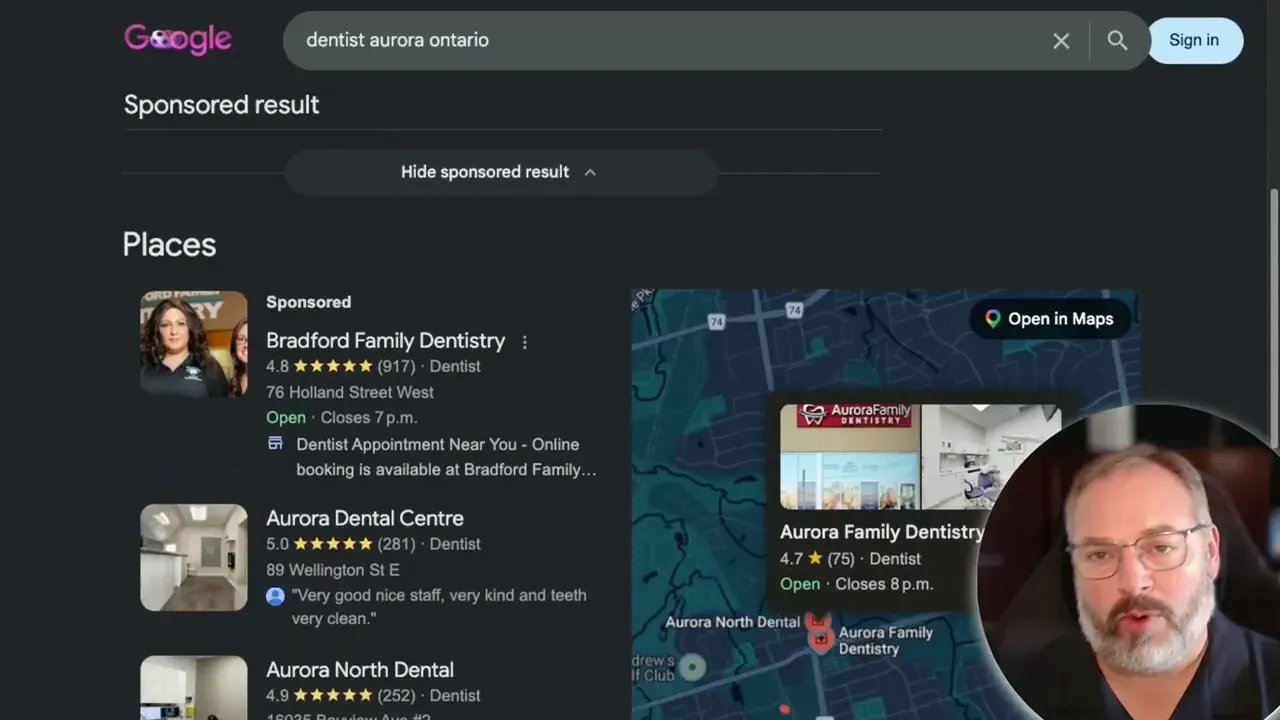
On the surface, that practice looks dominant. Strong search presence. Good local position. The kind of result many clinic owners would be thrilled to have.
But once you move from Google rankings into AI recommendation analysis, the picture changes fast.
Why? Because AI systems do not simply mirror search rankings. They pull from a mix of sources, patterns, associations, summaries, third party references, and signals that may not line up neatly with your current SEO assumptions.
In other words, your clinic can be highly visible in one environment and much less visible in another.
That gap is where patient loss happens.
And the dangerous part is that most practice owners never see it. They are checking Google. They are celebrating ranking reports. They are reviewing website traffic. Meanwhile, patients using AI may be getting pointed somewhere else altogether.
That is not a small technical issue. It is a patient acquisition issue.
What happens when patients bypass Google and ask AI directly?
Imagine a patient skips the usual search process and instead asks an AI assistant for a local dentist who meets their needs.
That conversation might include preferences like:
- Accepting new patients
- Family friendly care
- Insurance compatibility
- Value conscious pricing
- Convenient location
- Specific treatment needs
The AI then delivers a curated answer. Not ten blue links. Not a map pack with several choices. A direct response with selected clinics.
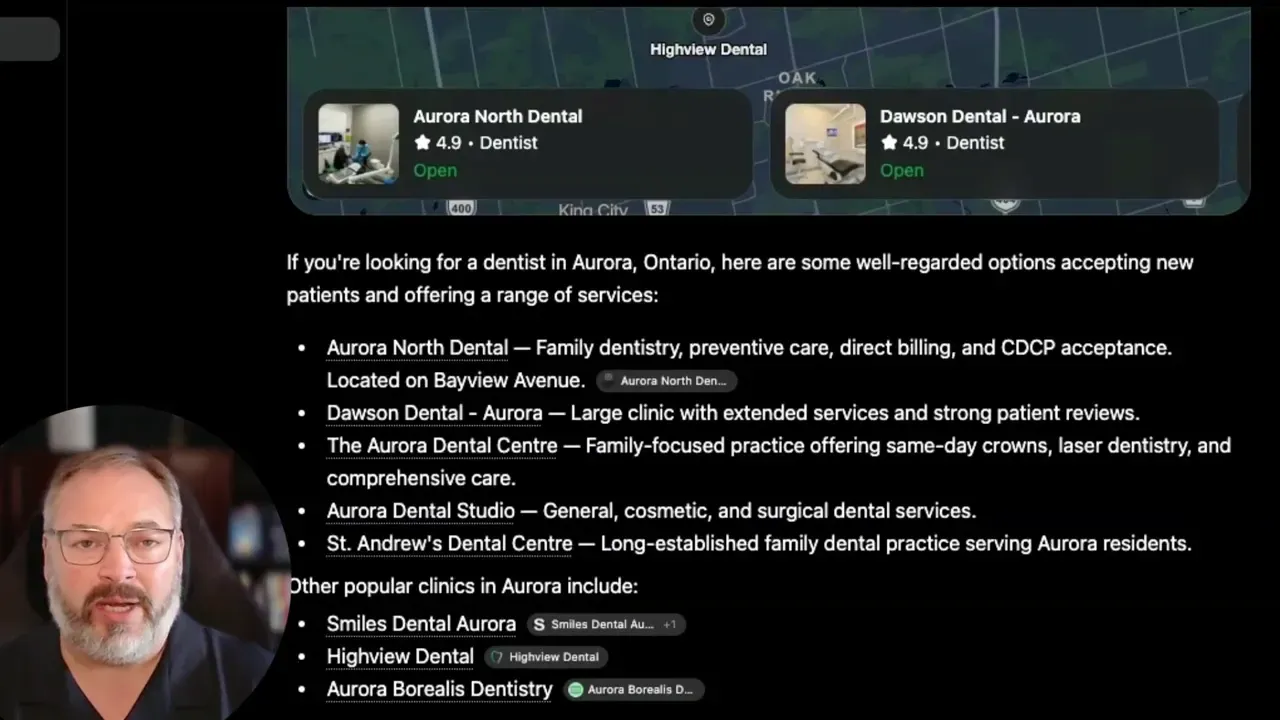
That means the AI is effectively acting as an intermediary between your clinic and the patient. If it understands your practice well and sees strong signals across the web, you may get included. If not, someone else gets the recommendation.
This is where many clinics discover they have a serious vulnerability.
The old search model gave you more chances to be considered. A patient could compare listings, click a few websites, read reviews, and eventually find you. AI compresses that process. It can reduce a wide open local market into a short shortlist.
If you are not on that shortlist often enough, you are not just less visible. You are excluded from the decision set.
The shocking gap between Google leadership and AI visibility
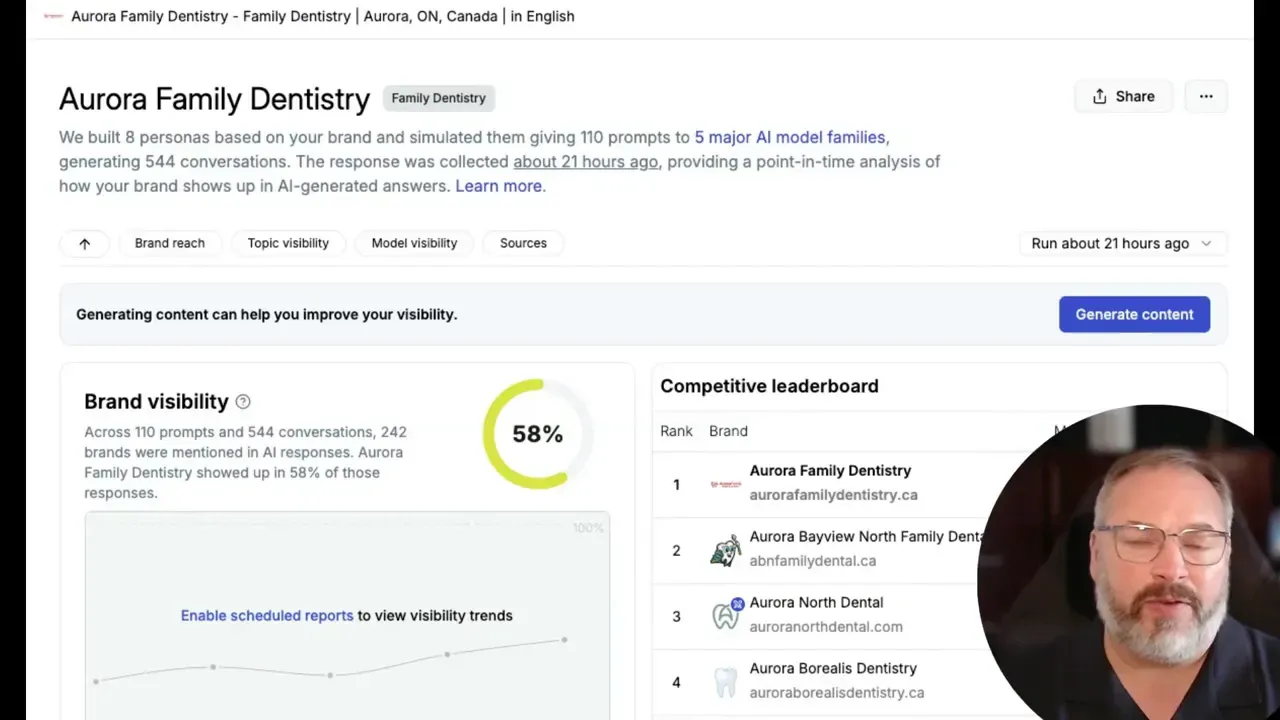
When the Aurora practice was analyzed with an AI recommendation diagnostic, the results were eye opening.
Despite being the organic leader in Google, the clinic showed only 58 percent brand visibility across AI recommendation scenarios.
Read that again.
A clinic that appears to be winning the market through traditional search is only being surfaced a little over half the time in AI recommendation environments.
Which means more than 40 percent of the time, AI is recommending someone else.
That is not a rounding error. That is not a minor optimization detail. That is a huge strategic leak.
It means the practice is not actually controlling local digital visibility as thoroughly as it thought. The gap between perceived dominance and actual recommendation share is substantial.
This matters because AI recommendations feel more authoritative to users. A lot of people interpret a direct AI answer as a filtered, intelligent best option. Whether that trust is always deserved is a separate conversation. The practical reality is that these answers influence choices.
If your practice is absent or inconsistently included, that absence starts costing you.
Cold zones are where your highest value patient opportunities disappear
One of the most useful ideas in this whole process is the concept of a cold zone.
A cold zone is an area where your practice becomes weak or invisible in AI recommendations for a specific kind of patient or search intent.
You may still show up for general queries. You may still rank in Google. But for a meaningful subset of local patients, your clinic is no longer the obvious answer in AI generated results.
In the Aurora example, one of the biggest weak spots appeared among insurance reliant and value conscious patients. For that persona category, the clinic's visibility dropped to just 41 percent.
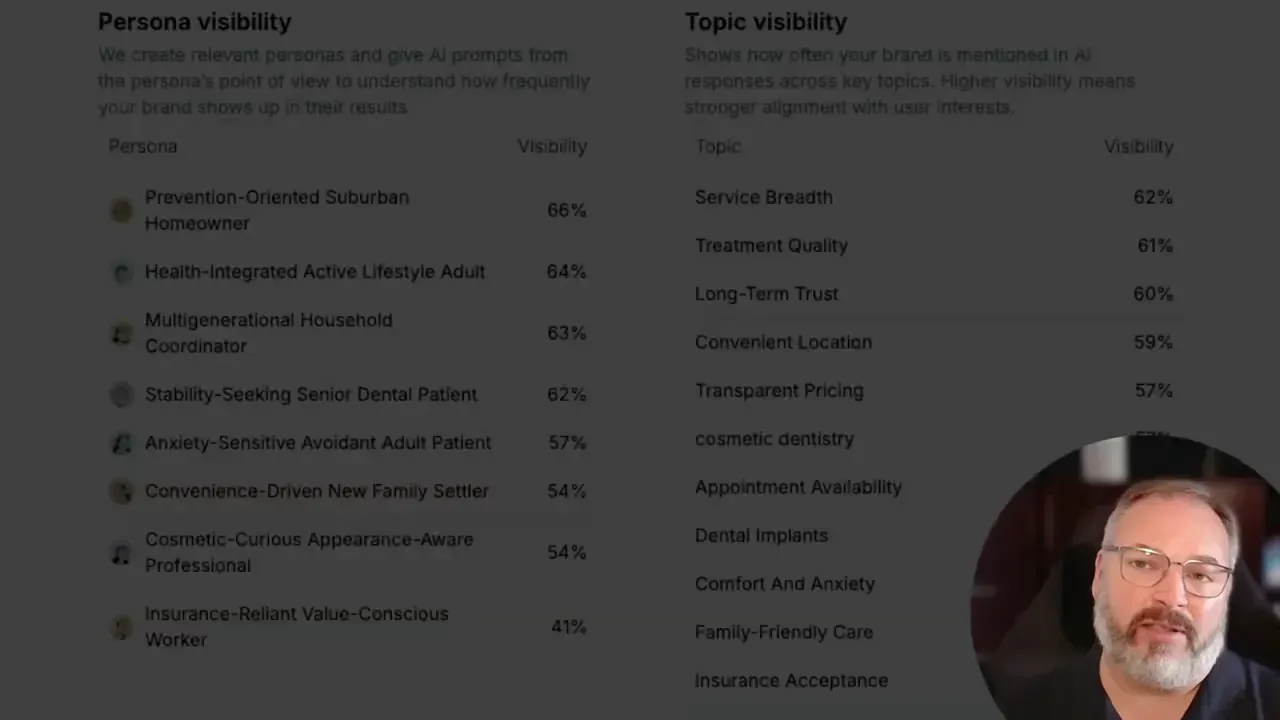
That is a serious drop from the overall visibility score.
This is exactly why broad averages can be deceptive. If you only look at your overall web presence, you may think things are fine. But your most commercially important patient segments may be seeing a completely different version of the market.
Some practices are invisible to price sensitive families. Others are weak for emergency care. Others are not associated strongly enough with cosmetic treatments, convenience, or family friendliness. Each of those gaps creates an opening for a nearby competitor.
Why persona visibility matters more than vanity rankings
One of the biggest mistakes in dental marketing is treating all searchers like they are the same.
They are not.
Some are looking for affordability. Some want premium cosmetic work. Some are anxious and need reassurance. Some need a clinic that works with insurance. Some care most about convenience, same day booking, or family scheduling.
AI systems are increasingly tuned to these subtleties.
That means your digital footprint needs to communicate not only that you exist, but also who you are the right fit for.
A persona based approach helps reveal whether AI sees your clinic the way you want it to. Are you strongly connected to preventive family care? To cosmetic dentistry? To value? To accessibility? To emergency service? To insured patients?
If those associations are weak, your practice can lose recommendation share even when you are objectively a good choice.
This is one reason content, reviews, service pages, directory consistency, and external citations matter in a broader strategic way. They are not just ranking factors anymore. They help shape how your clinic is interpreted by AI systems.
What an AI recommendation diagnostic actually shows you
This is where diagnostics become useful.
Instead of guessing, assuming, or relying on generic SEO dashboards, an AI recommendation diagnostic is built to show how your practice appears across multiple AI recommendation environments.
The diagnostic maps a dental clinic across 11 major AI engines simultaneously.
A strong diagnostic should help answer questions like:
- How often is your clinic being recommended?
- Which competitors are gaining share in AI search?
- Which patient personas are your strongest and weakest?
- Which treatment topics or positioning angles perform best?
- Where are your cold zones?
- Which outside sources are shaping AI recommendations about your clinic?
Most dental practices focus primarily on their own website and Google Business Profile. But AI systems frequently build answers using a wider ecosystem of information sources. That can include directories, review sites, location signals, competitor sites, summary pages, and other third party references.
The heat map makes hidden visibility gaps impossible to ignore
A useful report is not just a score. It gives you a visual way to understand where your clinic is strong and where it is vulnerable.
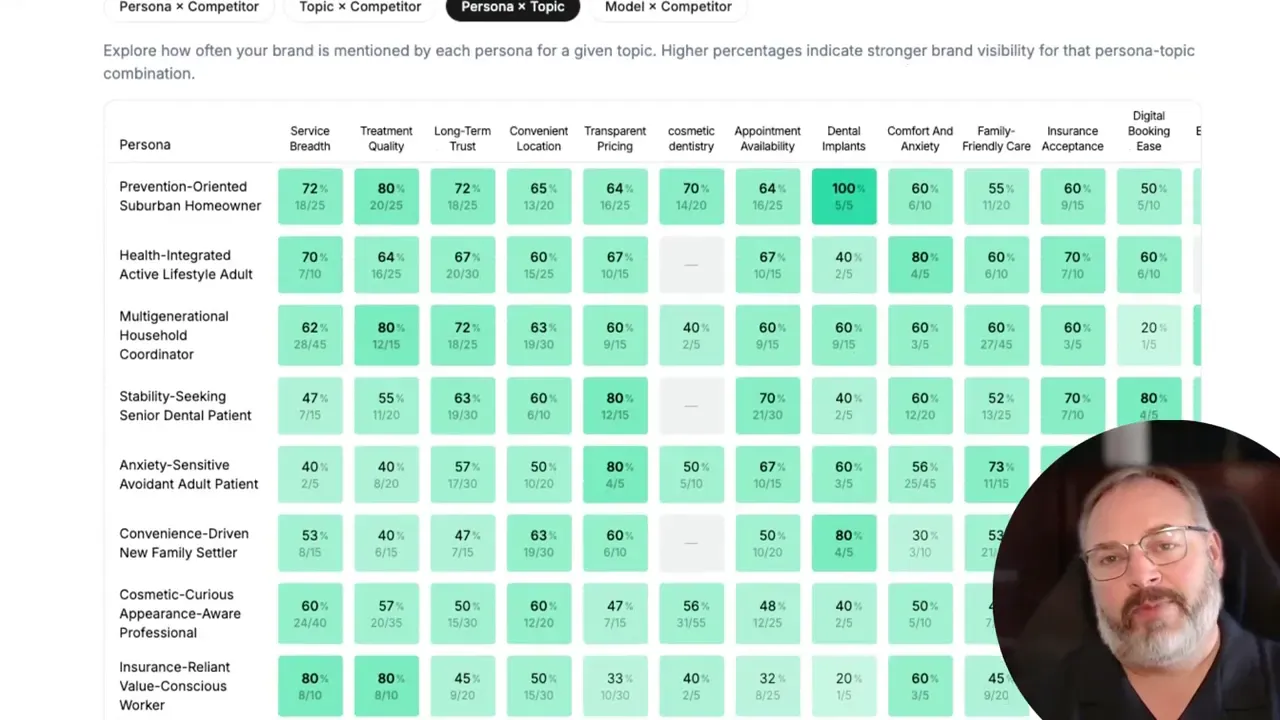
Instead of looking at one percentage in isolation, you can see a grid of recommendation performance across different combinations of personas, services, and contexts. This is where patterns jump out.
You can identify clusters of strength, where your clinic is frequently recommended, and clusters of weakness, where you are underperforming.
Without this kind of map, teams tend to default to broad tactics. They create a little more content, tune up a page, update some listings, and hope for the best. With a heat map, you can be much more targeted.
You are no longer trying to improve everything at once. You are focusing on the scenarios where lost visibility is most likely hurting patient acquisition.
Third party sources influence AI recommendations more than most clinics realize
One of the most overlooked parts of AI search visibility is the role of outside sources.
AI does not form an opinion about your clinic based only on your homepage. It pieces together signals from multiple places, including Google related data, local directories, review platforms, practice profile listings, competing clinic websites, and topical references that associate your clinic with certain services or values.
This creates a very different optimization challenge from old school SEO. You are not only trying to improve your own website. You are also trying to improve the ecosystem of signals that AI tools rely on when they summarize the local market.
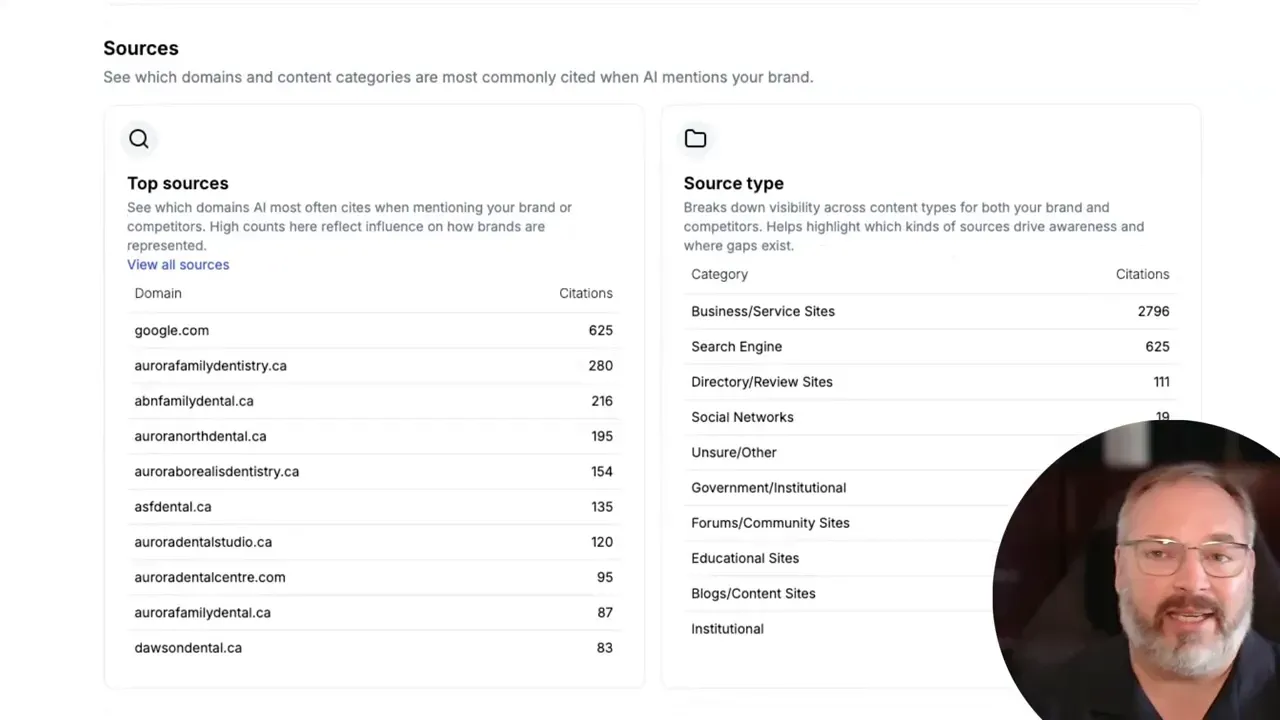
If a competitor has stronger or more consistent references across those sources, they may outperform you in AI recommendations even if your website is better or your Google ranking is higher.
This is also why directory management, review strategy, citation consistency, and strong positioning matter so much. AI is pattern hungry. It rewards clarity and repeated reinforcement.
The real value is the action blueprint, not just the diagnosis
A diagnostic is only useful if it leads to better decisions.
The point is not to hand over a bloated spreadsheet and leave your team buried in metrics. The point is to produce a clear blueprint for action.
Once you know where your visibility is weak, the next step is to close those gaps with purpose.
That can involve strengthening how your clinic is positioned around specific patient personas, tightening service related signals, improving supporting content, reinforcing key directories, and ensuring the web has a clearer and more consistent understanding of your strengths.
The process becomes much more strategic when you know:
- Which high value patient segments are underexposed
- Which competitor is winning those segments
- Which topics or associations are missing
- Which external sources need attention
- Which visibility gaps have the biggest commercial impact
Why this matters right now for dental practice growth
This shift is happening now, not someday.
AI assistants are quickly becoming a first stop for local service discovery. Dental practices that treat AI recommendations as a fringe issue are likely to fall behind clinics that adapt earlier.
The window to gain an advantage is still open, which is exactly why this matters.
Many practices have not even considered whether ChatGPT, Gemini, or other AI engines can accurately describe and recommend them. That means there is still room to identify the blind spots, improve visibility, and take share before everyone catches up.
Practices that understand how they are perceived by AI will be in a much better position to:
- Protect local market share
- Improve new patient acquisition
- Reduce invisible losses to nearby competitors
- Strengthen positioning with high value patient groups
- Future proof their local digital strategy
Stop guessing and start measuring AI visibility
If your clinic is serious about growth, this is not something to leave to assumptions.
You need to know whether your practice is being recommended, how often it is happening, where the weak spots are, and what is influencing those outcomes.
The goal is simple: step inside the black box, expose the blind spots, and give your marketing team a practical roadmap to reclaim missed opportunity.
Because if AI is already part of how people choose local dental care, then the real question is no longer whether your clinic ranks on Google.
The real question is this: When someone asks AI for a dentist in your area, does it send them to you or to the clinic down the street?
If you need help building an integrated growth engine, schedule a free strategy session.
Frequently Asked Questions
Why can a dental practice rank number one on Google and still lose patients through AI search?
Because AI assistants do not simply repeat Google's organic rankings. They generate recommendations using multiple signals, including third party sources, topical associations, directory data, and contextual intent. A clinic can lead in traditional search but still be inconsistently recommended by AI.
What is AI visibility for a dental practice?
AI visibility refers to how often your practice appears in recommendations from tools like ChatGPT, Gemini, and similar AI search engines when people ask for local dental services. It is a different metric from standard SEO rankings because it measures recommendation presence, not just search position.
What are cold zones in AI recommendations?
Cold zones are areas where your clinic has weak or low visibility in AI recommendations for specific patient types or treatment related searches. For example, your practice may perform reasonably well overall but become much less visible for insurance focused or value conscious patients.
Why do patient personas matter in AI search?
AI tools often respond to intent rich questions, not just generic search phrases. That means they may recommend different clinics depending on whether someone is looking for affordability, family care, convenience, preventive services, or a specific treatment. Persona visibility helps reveal whether your clinic is being matched to the right patients.
What does an AI recommendation diagnostic include?
An AI recommendation diagnostic can show your overall recommendation visibility, competitor comparisons, weak persona segments, topical strengths and gaps, and the outside sources AI appears to rely on when describing and recommending your clinic. The purpose is to turn hidden visibility issues into a usable action plan.
Do traditional SEO and Google Business Profile still matter?
Yes. Traditional SEO still matters a lot. Google rankings, reviews, local authority, and a strong business profile remain foundational. The difference is that they are no longer enough by themselves. Practices now need to understand both classic search performance and AI recommendation performance.
How can a dental practice improve AI recommendation visibility?
The first step is measuring where visibility gaps exist. From there, improvement usually involves strengthening positioning around the right patient personas, tightening content and service related signals, improving supporting third party sources, and closing inconsistencies that weaken how AI systems interpret your clinic.
Ian Cantle
Founder & Chief Marketing Strategist
Ian Cantle has spent over 20 years helping independent dentists and orthodontists dominate their local markets, build strategy-first marketing systems, and increase practice valuation.
Ready to Put This Strategy to Work in Your Practice?
Book a free Discovery Call with Ian Cantle. We will evaluate your local market, search presence, and patient acquisition strategy with no pitch and no obligation.
Book Discovery Call With IanRelated Insights
View All PostsCDCP Challenges for Canadian Dentists: Audits, Payment Holds and Patient Mix
CDCP is helping millions of Canadians access dental care, but participating practices face claims verification, payment delays, administrative pressure and patient-mix challenges. Ian Cantle examines the risks and explains how strategy-first marketing can support a healthier, more profitable practice.
Should I Abandon SEO for AI search?
Should I abandon SEO for AI search? With ChatGPT, Claude, and Gemini changing how people find answers, many practice owners worry they must pivot everything. The short answer: Do not abandon SEO — expand it into Generative Engine Optimization.
5 Easy Ways To Use AI In Your Dental Practice Without Overcomplicating Things
AI sounds like something reserved for big tech companies and Silicon Valley, right? But here's the truth: AI has never been more accessible for dental practice owners.