Stop Random Dental Marketing: Why AI-Generated Posts and Ads Aren't Filling Your Chairs
AI lets you pump out posts, ads and emails in minutes, so many practices do more marketing than ever with no plan tied to the patients they want. That creates noise, not new patients. Here's the strategy-first fix.

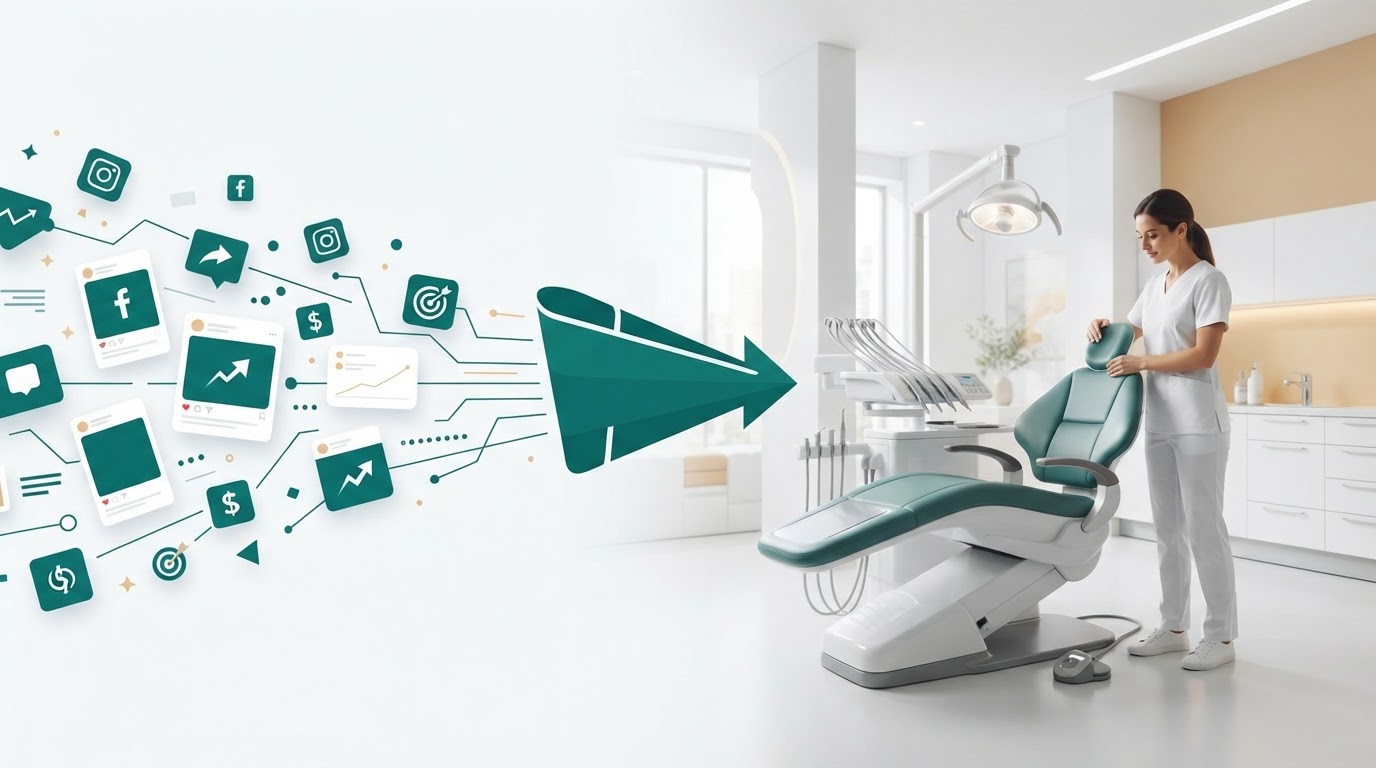
- Random marketing is tactics with no system — and AI lets you do more of it, faster, which just makes the noise louder.
- A strategy-first plan decides which patients and procedures to grow, what makes your practice different, and which few activities bring those patients in.
- AI search tools (ChatGPT, Gemini, Google AI Overviews) reward practices with clear, consistent information — random marketing creates the opposite.
- Start with your patient profile, practice story and voice; focus on two or three channels; and connect every post to a next step.
AI lets practices pump out posts, ads and emails in minutes, so many do more marketing than ever with no plan tied to the patients they want. That creates noise, not new patients. The fix is deciding which patients and procedures to grow, what makes the practice different, and which few activities bring those patients in — then using AI to execute.
What is random dental marketing?
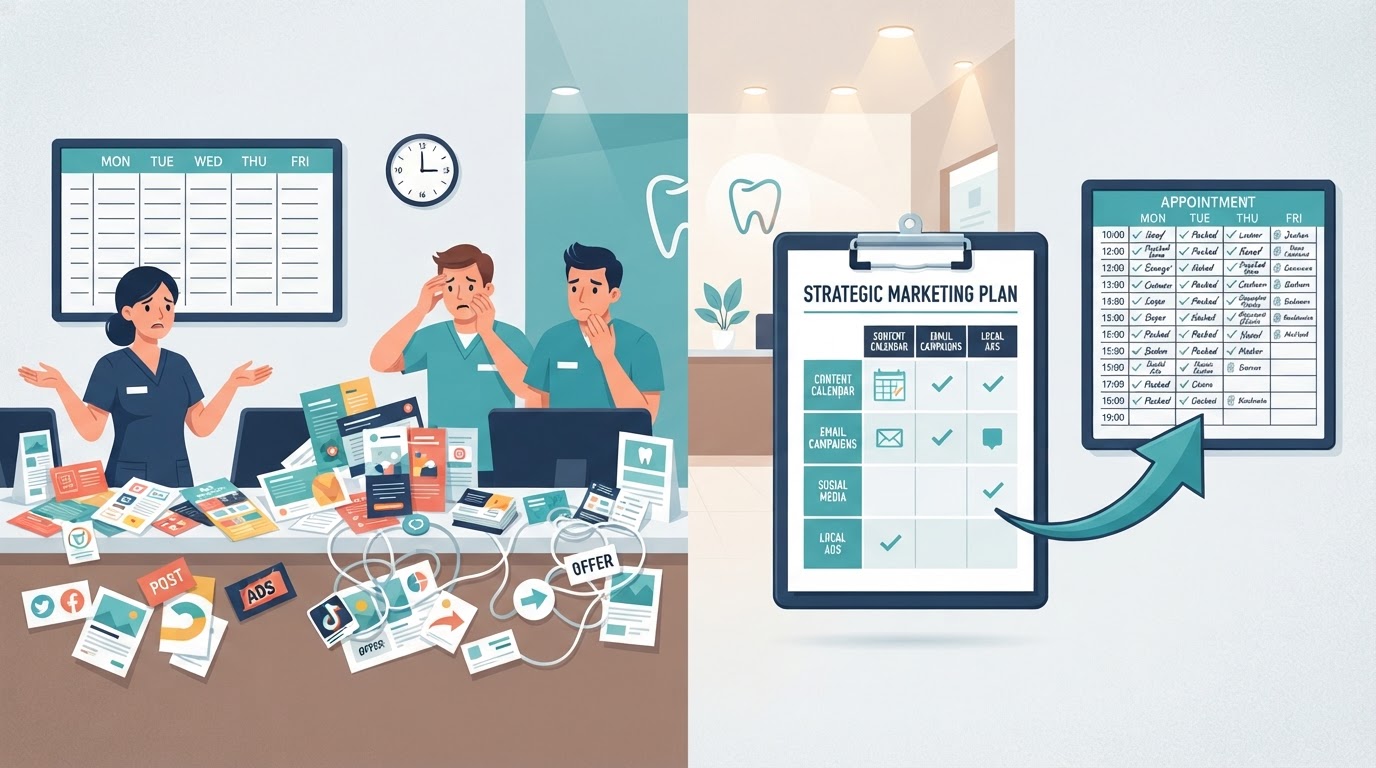
Random dental marketing is tactics with no system behind them. A whitening promo one month, a mailer the next, a new website because the old one felt dated, an Instagram burst when the schedule looks thin. Each activity is launched because someone had a moment of energy or a vendor called — not because it's the next logical step in a plan.
The tell-tale sign is that results swing and nobody knows which activity produced which patients. New patients show up, but no one can say whether it was the postcard, the Google ad, the blog post, or just word of mouth. So the team keeps guessing, and the next tactic is as random as the last one.
How is AI making dental marketing worse?
AI didn't invent random marketing, but it made it cheaper to produce. Here's how that backfires:
- 1.More content, same empty chairs — everyone posts the same flossing tips and "happy Friday" graphics, so the feed fills up but the schedule doesn't.
- 2.Your practice starts to sound like everyone else's — generic AI drafts flatten your voice until you're indistinguishable from the clinic down the street.
- 3.Tool-hopping — a new AI tool every week, each promising to be the missing piece, while nothing actually connects to a plan.
- 4.Speed skips the thinking — when you can publish in minutes, the question "Which patients do we actually want more of?" never gets asked.
- 5.AI search rewards clarity, and random marketing creates confusion — patients now ask ChatGPT, Gemini and Google AI Overviews to recommend a dentist, and those tools favour practices with clear, consistent information and detailed reviews. BrightLocal's 2026 Local Consumer Review Survey found that use of ChatGPT and other AI tools for local recommendations jumped from 6% to 45% in a year.
We cover this in depth in What Is Dental GEO SEO?.
What does strategy-first dental marketing look like?
Strategy-first means the plan comes before the tactics. Before you write a single post or launch a single ad, you've answered the questions that make marketing actually work:
- Ideal patients and procedures — families, implants, Invisalign, cosmetic, emergency. You've named the two or three you most want to grow.
- Your practice's difference, said the same way everywhere — the same message on your website, Google profile, ads and social, not a different pitch each time.
- The patient journey — find, trust, book, return, refer. You know where each tactic fits in that path.
- The right marketing mix for your capacity — choose tactics that fit your time and budget using the capital-and-time matrix for dental marketing.
- A few numbers tracked monthly — new patients, source, case acceptance, reviews. You can see what's working and what isn't.
| Random | Strategy-first | |
|---|---|---|
| Starting point | A promo or a new tool | The patients and procedures you want to grow |
| Channels | Whatever a vendor pitched | Google Business Profile, website and one social channel |
| Content | Generic flossing tips | Your team, your cases with consent, your community |
| Measurement | Likes and clicks | New patients by source and case acceptance |
| AI search | Mixed signals | One clear, consistent message |
Every marketing message your practice publishes must also follow the RCDSO's advertising guidelines.
How can you use AI in dental marketing without going random?
AI is a brilliant executor and a terrible strategist. Use it to do the work once the plan is set:
- 1.Give AI your patient profile, practice story and voice first. Feed it who you serve, what makes you different, and how you sound — before it writes anything.
- 2.Focus on two or three channels, usually Google Business Profile, your website and one social channel. Depth beats scattered presence.
- 3.Edit every draft to add real cases (with consent), your team and your community. Strip out the generic and put in what only your practice can say.
- 4.Connect every post to a next step — a service page, an offer, or online booking. No dead-end content.
- 5.Review monthly. Look at the numbers, keep what's working, drop what isn't, and adjust the plan.
If blogging is part of your mix, here's how to get real traffic from a dental practice blog.
Is your dental marketing random? 60-second check
Answer honestly:
- Can you name the 2-3 procedures you most want to grow?
- Do your website, Google profile and social media share one consistent message?
- Do you know where your last 10 new patients came from?
- Do you have a written 90-day marketing plan?
Two or more "no" answers means adding AI tools will just make the randomness louder — faster output, same lack of direction.
What does strategy-first look like in a real practice?
Dr. Jesse Chai's practice competes with 17 dental clinics within 1.5 miles. He was spending heavily on marketing with diminishing returns, and that marketing was fragmented across vendors that didn't talk to each other. Worse, a Google Ads campaign was silently sending more than $10,000 CAD over three months to 404 pages.
We started with an audit, stopped the wasted spend on day one, and consolidated SEO, web, ads, reviews and email into one accountable system. The results: a 29X documented return on marketing investment, 5X qualified leads, 700+ five-star Google reviews, and a $270,000 peak production month — the highest in the practice's 20+ years. That's what strategy-first looks like when it's actually executed.
Read the full Bradford Family Dentistry case study.
Where should your practice start?
Dental Marketing Heroes helps practices build a strategy-first marketing system, then executes it — including dental SEO and AI search visibility. Start with a free dental marketing checkup or book a discovery call.
What is random dental marketing?
Marketing tactics launched with no system behind them — a promo here, a mailer there, a website refresh because the old one felt dated. Results swing and nobody knows which activity produced which patients.
Is AI bad for dental marketing?
No, but it's an amplifier. Used inside a clear plan, AI speeds up execution. Used without one, it just produces more random content faster — more noise, not more patients.
What should a dental marketing plan include?
Your ideal patients and procedures, your practice's difference said consistently, the patient journey, the right mix of channels for your capacity, and a few numbers tracked monthly.
How does random marketing affect AI search?
AI search tools like ChatGPT, Gemini and Google AI Overviews recommend practices with clear, consistent information and detailed reviews. Random, inconsistent marketing confuses those tools and hurts your visibility.
How many marketing channels should a dental practice use?
Usually two or three done well — often Google Business Profile, your website and one social channel. Depth on a few channels beats a thin presence everywhere.
Ian Cantle
Founder & Chief Marketing Strategist
Ian Cantle has spent over 20 years helping independent dentists and orthodontists dominate their local markets, build strategy-first marketing systems, and increase practice valuation.
Ready to Put This Strategy to Work in Your Practice?
Book a free Discovery Call with Ian Cantle. We will evaluate your local market, search presence, and patient acquisition strategy with no pitch and no obligation.
Book Discovery Call With IanRelated Insights
View All PostsWhat is Dental GEO SEO? Understanding Generative Search for Dentists
Demystifying Generative Engine Optimization for dentists and orthodontists. Why your website structure must communicate clearly with AI crawlers.
Dental Marketing in 2026: Sweat Equity vs Paid Ads Strategy – Capital-and-Time Matrix
If you can drill the perfect composite and place a flawless crown, you already know what clinical excellence looks like. But clinical skill alone doesn't fill your schedule. In 2026, evaluate your growth using the Capital-and-Time Matrix.
Get More (And Better) Traffic In 2022 With Your Local Dental Practice Blog
You already know that content marketing is widely considered to be essential for your dental practice. Maybe you've already got a dental practice blog that gets some organic traffic. What's next? The sad truth is that most local practices aren't blogging about the right things in the right way. As a result, they're losing patients […]