
Dental SEO & GEO in 2026: The Ultimate Growth Formula for Practice Dominance
How Generative Engine Optimization (GEO) paired with technical dental SEO creates an unshakeable competitive moat in local patient search.

- GEO (Generative Engine Optimization) optimizes for entity citation rather than pure keyword frequency.
- Google's Search Generative Experience (SGE) favors dental practices with deep clinical topic clusters.
- Map Pack 3-Pack rankings feed directly into AI search engine recommendations.
Dental patient acquisition is changing fast. A practice no longer needs to be found only on Google — it needs to show up wherever people search, including ChatGPT, Gemini, Perplexity, and other AI platforms. Learn the new SEO + GEO growth formula for 2026.
Introduction
Dental patient acquisition is changing fast. A practice no longer needs to be found only on Google. It needs to show up wherever people search for answers, recommendations, and local providers, including Google Maps, Gemini, ChatGPT, Perplexity, Claude, Bing, and other AI search platforms.
That is where SEO plus GEO comes in. SEO, or search engine optimization, helps your practice earn visibility in traditional search. GEO, or generative engine optimization, helps AI-powered search tools understand who you are, what you do, where you are located, and why your practice is a credible recommendation.
The goal is not random acts of marketing. The goal is to build a systematic growth engine that improves your digital footprint, brings in qualified leads, converts more of them into appointments, and lets you measure what is actually producing a return.
Meet Ian Cantle
At Dental Marketing Heroes, the focus is simple: help good dental practices build great marketing, attract great patients, grow sustainably, and enjoy the work of running a practice.
That requires more than a nice-looking website or a few ads. It requires a connected system that combines search visibility, local authority, patient trust, conversion optimization, automation, and measurable ROI.
The New SEO + GEO Formula
The new formula is built for two search environments at once:
- Traditional search: Google organic listings, Google Maps, local pack results, and Bing.
- AI search: ChatGPT, Gemini, Perplexity, Claude, and other large-language-model search tools.
These platforms need clear signals before they can confidently recommend a dental practice. Your website content, structured data, Google Business Profile, reviews, citations, backlinks, service pages, and reputation all contribute to those signals.
In other words, visibility is not merely about inserting a keyword onto a page. It is about proving your expertise, authority, trust, location, services, and patient experience across the web.
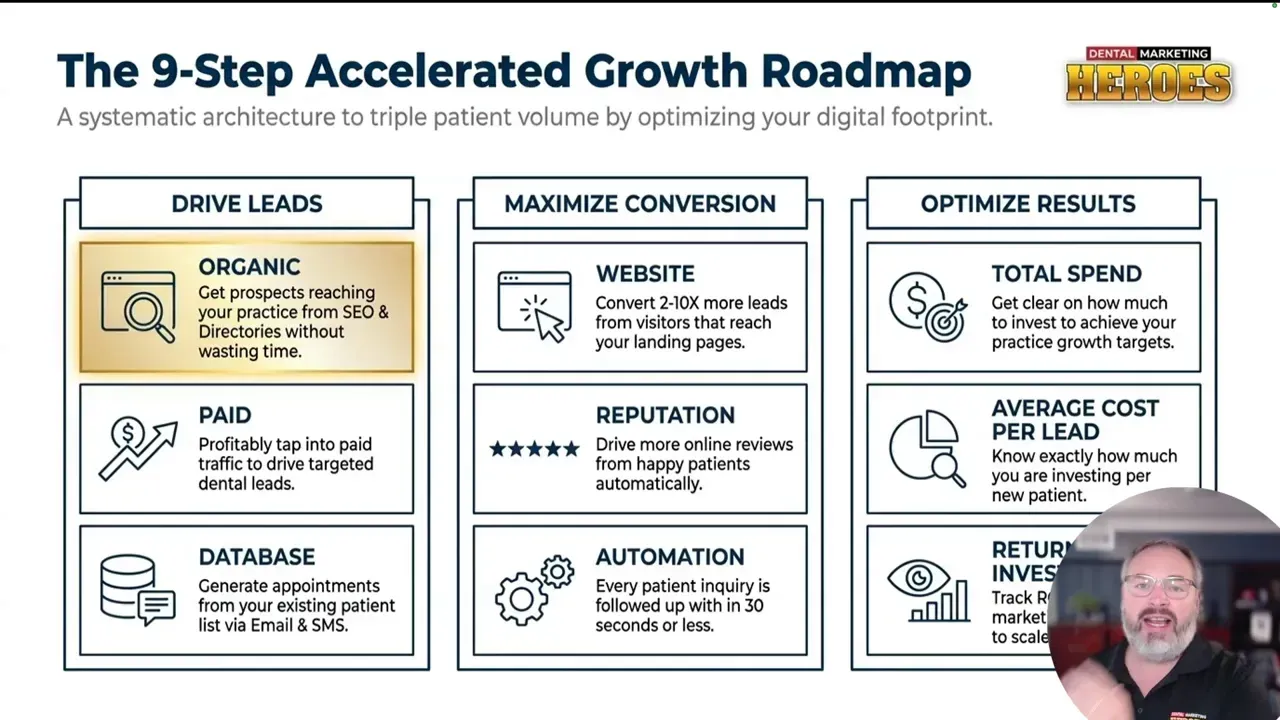
The 9-Step Growth Roadmap
The accelerated growth roadmap is organized around three core areas: driving leads, maximizing conversions, and optimizing results. Within those three areas sit nine practical growth levers.
- 1. Organic search
- 2. Paid traffic
- 3. Database reactivation
- 4. Website conversion
- 5. Reputation and reviews
- 6. Marketing automation
- 7. Total marketing spend
- 8. Cost per lead
- 9. Return on investment
This is the architecture of a practice growth engine. You can generate all the leads in the world, but if the website, team, reviews, and follow-up process are weak, those opportunities simply move to the dentist down the street.
Driving Leads Overview
Lead generation should not depend on one channel. A durable dental marketing system uses three engines.
- Organic visibility: Earn rankings on Google, Maps, and AI search platforms.
- Paid traffic: Use advertising to create targeted demand quickly and profitably.
- Database reactivation: Reconnect with existing and inactive patients who already know your practice.
Your patient database is a goldmine. Unless you opened yesterday, there are likely patients in your records who are overdue, inactive, or in need of follow-up. Reactivation is often one of the most overlooked ways to generate appointments. For a deeper look at this opportunity, read the guide to patient reactivation campaigns.
Organic Search Strategy
Organic search is the long-term foundation of patient acquisition. It is where trust compounds.
Paid ads can be valuable because you can increase or decrease activity quickly. But ads have temporary visibility. When the budget stops, the traffic stops. Organic rankings require continuous investment too, but their long-term economics are very different because you are not paying Google for every individual click.
Organic SEO and Maps create trust because people can see that your practice has earned its position, has reviews, and appears relevant to their needs. The task is to give search engines and AI platforms enough clear, consistent evidence to choose you as a recommendation.
Maximizing Conversions: Website, Reviews, Automation
Traffic is not the finish line. Appointments are. Your website should make it easy to understand your services, trust your practice, call, book, or submit an inquiry.
Reviews help remove uncertainty. A strong reputation can influence whether a prospective patient chooses to contact you at all. Then, when an inquiry does arrive, speed matters. If a person reaches out and hears nothing, they will often contact the next practice.
A good marketing automation system can help initiate a timely response, ideally within 30 seconds or less. Practice management software is excellent for managing the practice, but it is often not designed to handle the full marketing follow-up process. Marketing automation fills that gap and supports the human-to-human connection people expect.
Conversion improvement is often the fastest path to better marketing performance.
Optimizing Results: Spend, CPL, ROI
Marketing without measurement becomes guesswork. Every practice should be clear on three numbers:
- Total spend: How much must be invested to reach the growth target?
- Cost per lead: What does each inquiry cost by source?
- Return on investment: Which channels are producing a meaningful return, and which are not?
Track results by channel, not only in total. That lets you decide where to increase investment, where to pull back, and where a conversion issue is creating waste. SEO, Google Ads, Maps, reactivation, reviews, and social activity can all contribute differently to the final outcome.
Patient Search Behavior Stats
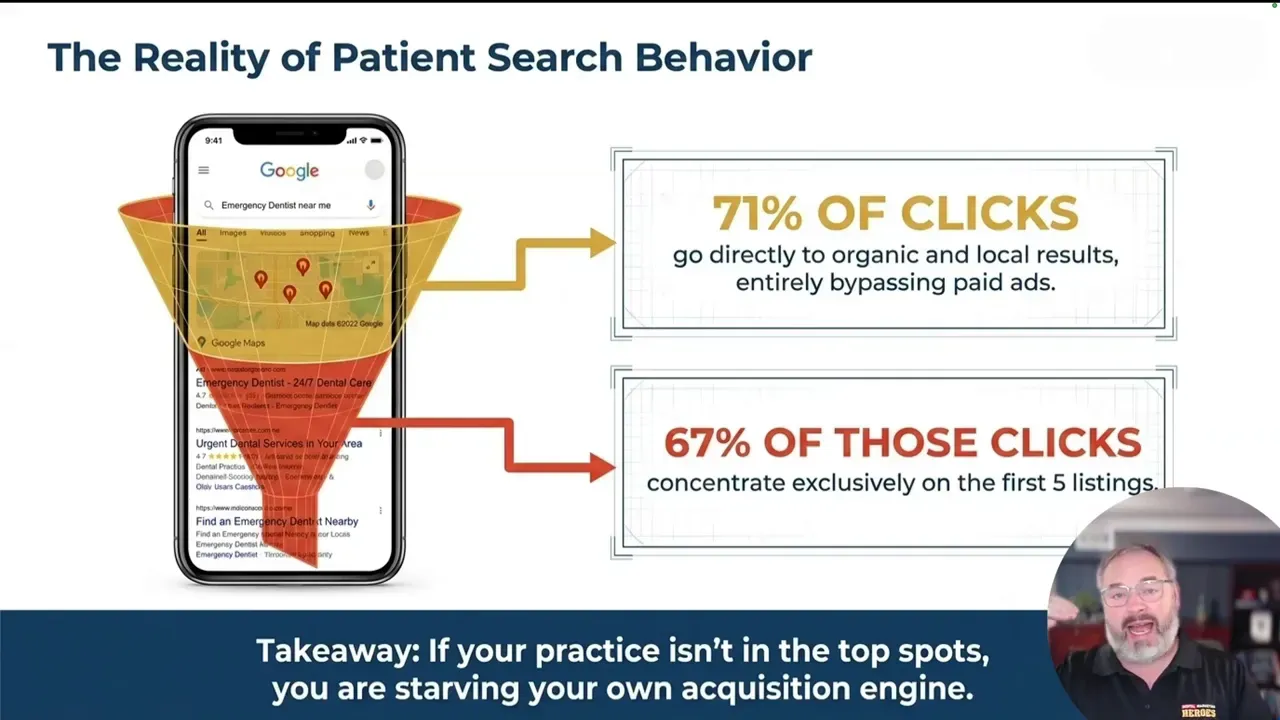
The opportunity at the top of search results is enormous. Search behavior varies by market and competitiveness, but the pattern is very clear: 71% of clicks go directly to organic and local results, bypassing paid ads.
Even more important, 67% of those clicks are concentrated in the first five listings. Most of the attention is concentrated at the very top, especially within the top three results.
If your practice is buried beyond those positions, you are handing high-quality patient opportunities to competitors. That is why rankings matter so much. In a high-volume practice example with 417 monthly leads, organic SEO and Maps account for 65% of total actions, including calls, forms, and map-driven actions.
Complexity of the Google Algorithm
Google uses more than 200 ranking factors, and search has become substantially more complex in recent years. The same broad principles now matter for AI search too. Your SEO system must address three major areas: technical foundation, on-page relevance, and off-page authority.
Technical foundation
Search engines need to crawl, index, and understand your website. The site should be secure, fast, mobile responsive, properly structured, and easy for search systems to interpret.
- HTTPS security
- Core Web Vitals and page experience
- Page-load speed
- Mobile responsiveness
- XML sitemap
- Canonicalization
- Schema and structured data
Schema is particularly important. It provides structured information that helps Google and AI platforms identify your business, services, people, locations, and page content without having to infer everything from text and images.
Do not assume a cheap AI-built website will solve these issues. A website can look acceptable while being poorly engineered for crawlability, relevance, structure, and rankings. That can create a serious opportunity cost by stalling your organic growth.
On-Page Relevancy & Content
Once the technical foundation is strong, your website has to prove relevance. Search engines need to see that your practice is a legitimate authority on the services you want to grow.
Take dental implants as an example. Mentioning implants briefly on a homepage is not enough to establish topical authority. A stronger practice might have:
- A dedicated dental implants service page
- A page addressing dental implant costs
- An implant FAQ page
- Educational articles about the treatment process
- Relevant internal links connecting all implant content
That body of information gives search engines a much clearer signal: this practice has meaningful expertise in dental implants.
Use keyword optimization intelligently through titles, headings, meta descriptions, URLs, internal linking, image alt text, and useful service content. But do not publish generic, unreviewed AI content. Easy content is everywhere now. Useful, accurate, focused content that reflects your actual practice is what stands out.
Content must also support a higher-trust standard. Dentistry falls into the "Your Money or Your Life" category because healthcare choices affect people's health and finances. Your site should demonstrate experience, expertise, authority, and trust, often referred to as EEAT.
Off-Page Authority & Backlinks
Off-page SEO is the proof that exists beyond your website. You control the technical and content work on your own site. Off-page authority is how the rest of the web supports your credibility.
Quality backlinks
When reputable sites link to your practice, they reinforce your authority. The best long-term approach is to earn those links through valuable, authoritative content and credible community or industry visibility.
Citation consistency
Your name, address, and phone number, often called NAP, must be accurate and consistent everywhere. This includes Google Business Profile, Bing Maps, directories, aggregators, Yelp, the Better Business Bureau, and other online listings.
Inconsistency is especially common after a practice relocation, phone change, merger, or rebrand. It might seem simple, but incorrect directory data can confuse search engines and AI systems about which information is authoritative.
Reviews, PR, and social signals
Patient reviews, press coverage, content syndication, and activity across platforms such as Google Business Profile, Facebook, Instagram, TikTok, and X all help reinforce the presence and legitimacy of your practice.
Reviews deserve special attention because people can value them as strongly as personal recommendations. You need a strong overall rating, but you also need review velocity. A steady flow of recent reviews signals that your practice continues to deliver a high level of care. Learn more in this guide on how to generate great dentist reviews.
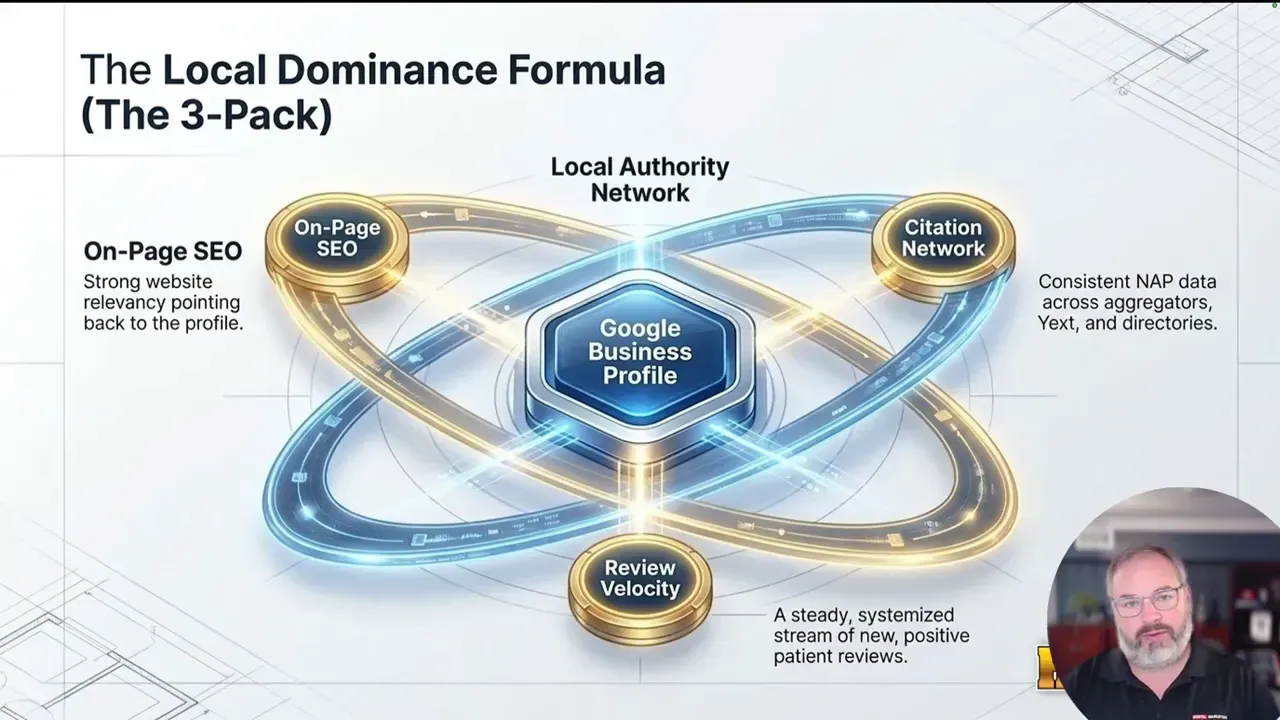
Local Dominance Formula (3-Pack)
Your Google Business Profile is central to local dental SEO. It helps Google understand who you are, where you are, what you offer, and whether your practice deserves visibility in local results. It also contributes signals used by AI-powered search systems.
Local dominance comes from three connected pieces:
- 1. On-page local relevance: Service pages, city relevance, clear practice information, and an optimized website.
- 2. Citation network: Accurate, consistent NAP information distributed across directories and aggregators.
- 3. Review velocity: A steady system for inviting happy patients to share their experience.
Your website and Google Business Profile should reinforce each other. Use accurate practice details, relevant services, current information, and an embedded Google Map where appropriate to strengthen that geographic connection.
The Patient Acquisition Flywheel
Great dental SEO is not a project you complete once. It is a flywheel. Each positive result helps create the next one.
Phase 1: Build the foundation
Claim and optimize your Google Business Profile. Improve Maps visibility. Create unique service pages. Fix technical SEO and website structure.
Phase 2: Publish useful content
Regularly create fresh dental insights and answers to common questions. That content supports rankings while giving you material for newsletters, social channels, your Google Business Profile, and other distribution channels.
Phase 3: Amplify authority
Earn stronger links, syndicate valuable content, maintain fresh map embeds, improve reviews, and let EEAT signals compound over time.
The cycle is straightforward: better signals create better rankings, which create more patient opportunities, which create more reviews and credibility, which create even better signals. When this is systematically engineered, it becomes difficult for competitors to catch up.
The Ultimate Dental SEO Checklist
Use this checklist to assess whether your dental practice has the essentials in place.
On-page basics
- Unique pages for core services and relevant cities
- Clear H1 headings and logical heading hierarchy
- Optimized titles, URLs, metadata, schema, and image alt text
- Original, helpful content with no duplicate copying
- Strong internal linking between relevant pages
Google Business Profile and local presence
- Claimed and actively optimized Google Business Profile
- Accurate data across aggregators and directories
- Consistent name, address, and phone number everywhere
- Ongoing system for generating reviews ethically and consistently
- Website and Google Business Profile aligned with one another
Ongoing authority engine
- Fresh content that answers patient questions
- Content syndication through appropriate channels
- High-authority do-follow backlinks earned over time
- Regular internal-link updates and content improvements
- Marketing automation synchronized with your practice systems where possible
Key Takeaways & Next Steps
The modern dental search landscape rewards practices that treat SEO as a disciplined, data-driven system. It is not guesswork, and it is not a collection of disconnected marketing tactics.
The practices that hold the top three to five positions on Google and Maps tend to control the largest share of available patient demand. AI search makes that concentration even more important because these platforms generally provide only a limited set of recommendations.
Start with the foundation. Audit your website, strengthen your Google Business Profile, correct your citations, build genuine service authority, establish a review-generation process, improve response speed, and measure performance. If you need help building an integrated growth engine, schedule a strategy session.
Frequently Asked Questions
What is GEO for dental practices?
GEO means generative engine optimization. It is the process of improving the online signals that help AI search platforms such as ChatGPT, Gemini, Perplexity, and Claude understand and recommend your dental practice. It works alongside traditional SEO rather than replacing it.
Why does my dental practice need SEO if I already run Google Ads?
Google Ads can produce traffic quickly, but visibility stops when the advertising budget stops. SEO creates long-term organic and local visibility, builds patient trust, and can improve the economics of new patient acquisition over time. The strongest strategy often combines both channels.
What is review velocity?
Review velocity is the ongoing pace at which your practice earns new patient reviews. A steady stream of recent positive reviews can strengthen trust with prospective patients and support local search visibility.
What are the most important local SEO factors for dentists?
The most important local SEO foundations include an optimized Google Business Profile, accurate name, address, and phone number data across directories, strong and recent reviews, relevant service pages, a technically sound website, and local authority signals such as citations and backlinks.
Can AI-generated content help a dental website rank?
AI can support the content process, but generic, unreviewed AI content is not a strong strategy. Dental content should be accurate, useful, original, strategically focused, and reviewed by people who understand the practice and the service being discussed.
Ian Cantle
Founder & Chief Marketing Strategist
Ian Cantle has spent over 20 years helping independent dentists and orthodontists dominate their local markets, build strategy-first marketing systems, and increase practice valuation.
Ready to Put This Strategy to Work in Your Practice?
Book a free Discovery Call with Ian Cantle. We will evaluate your local market, search presence, and patient acquisition strategy with no pitch and no obligation.
Book Discovery Call With IanRelated Insights
View All PostsIs ChatGPT Recommending Your Dental Practice or Sending Patients to Your Competitor?
If your dental practice ranks well on Google, it is easy to assume everything is under control. But patients are increasingly asking AI tools like ChatGPT and Gemini for recommendations — and your Google ranking does not automatically carry over. Here is what you need to know.
What is Dental GEO SEO? Understanding Generative Search for Dentists
Demystifying Generative Engine Optimization for dentists and orthodontists. Why your website structure must communicate clearly with AI crawlers.
Mastering Google Maps Marketing For Dentists: Strategies for Success
In today's digital age, Google Maps Marketing for dentists is more crucial than ever for attracting new patients. This comprehensive guide provides actionable insights and strategies to optimize your dental practice's online presence, ensuring you stand out in local search results.