How Patients Use AI to Choose a Dentist (and What Your Dental Marketing Must Do Now)
More patients ask AI tools like ChatGPT, Gemini and Google AI Overviews to recommend a dentist. The practices AI understands and trusts get the call — others are never considered. Here's what your dental marketing must do now.

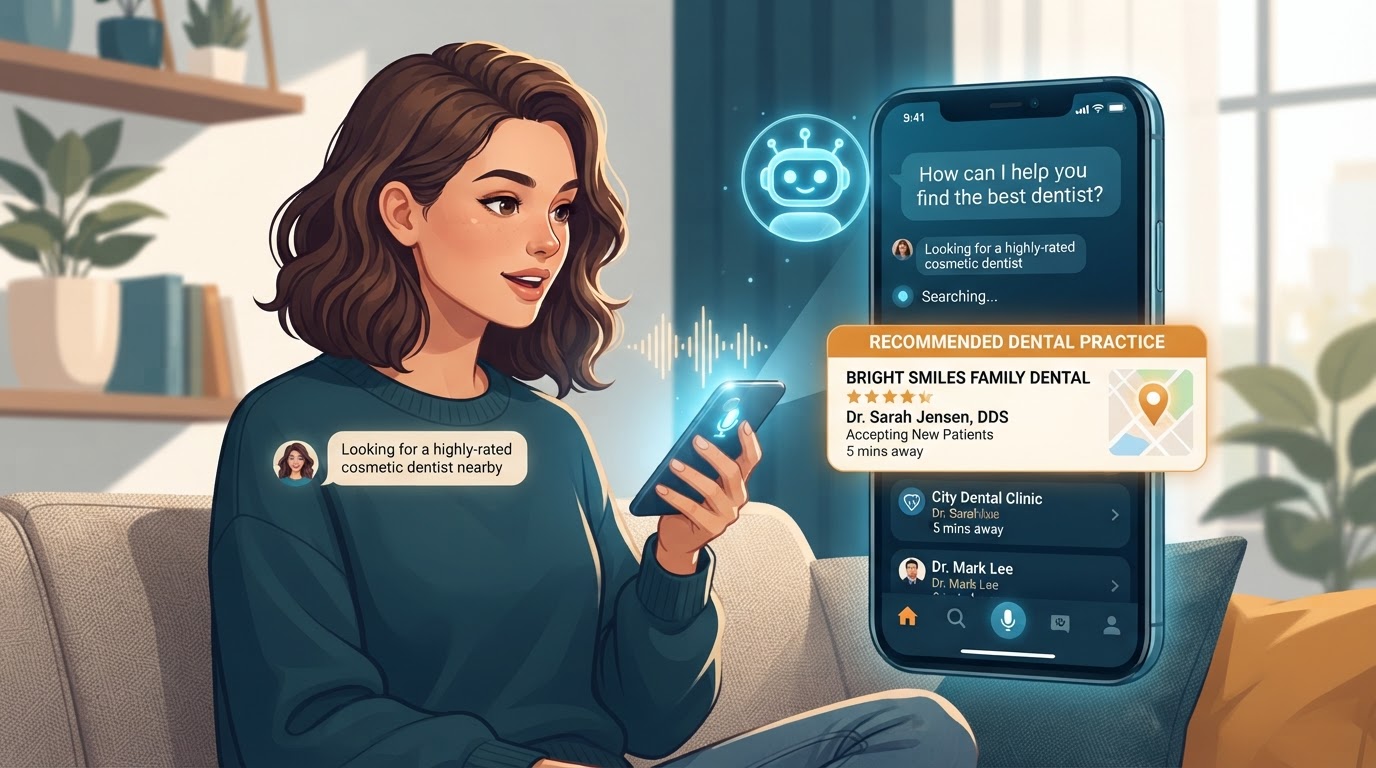
- Patients now ask ChatGPT, Gemini and Google AI Overviews questions like 'Who's a good dentist near me for nervous patients?' — and the AI answers with a few practices.
- AI favours practices with specific reviews, consistent information everywhere, detailed service pages and schema markup.
- Generic AI-written posts and inconsistent listings make a practice blurry to AI, so it's never recommended.
- Audit what AI says about your practice, fix your information everywhere, build a page per priority procedure, and add an FAQ to each one.
More patients ask AI tools like ChatGPT, Gemini and Google AI Overviews questions like 'Who's a good dentist near me for nervous patients?' The AI answers with a few practices based on reviews, consistent practice information and content that answers patient questions. Practices AI understands and trusts get the new-patient call — others are never considered.
What questions are patients asking AI?
Patients don't search the way they used to. Instead of typing a keyword and scrolling links, they ask an AI a full question and read the answer. The questions are specific:
- "Best family dentist near me accepting new patients"
- "Dentist who is good with anxious patients in [city]"
- "How much do dental implants cost in [city], and who's good?"
- "Emergency dentist open Saturday near me"
- "Invisalign vs braces: which dentist should I see?"
Notice how specific they are. AI rewards practices whose websites and reviews answer those specifics — the procedure, the comfort concern, the cost question, the hours. A generic 'we provide quality dental care' page answers none of them. Let's break down what each patient is really asking, and what your site and reviews need to say for AI to name you.
"Best family dentist near me accepting new patients"
This patient wants to know you're taking new families and that you actually serve kids. Your homepage and family dentistry page should state 'accepting new patients' plainly, mention the ages you see, and describe how a child's first visit goes. Reviews that say 'my kids love going here' give AI the exact language it's looking for.
"Dentist who is good with anxious patients in [city]"
Fear of the dentist is one of the most common patient concerns, and AI is asked about it constantly. Your site should name how you care for anxious patients — sedation options, a calm environment, unhurried appointments, a team trained to put people at ease. Reviews that mention 'gentle' and 'I finally felt safe at the dentist' are the signals AI reads and repeats.
"How much do dental implants cost in [city], and who's good?"
Cost is the question patients ask AI most about implants, and a page that dodges it gets skipped. You don't need to publish exact prices, but you should explain what affects the cost — the number of implants, bone grafting, the crown material — and how insurance, payment plans and financing work. Reviews from implant patients that mention the process and the result tell AI you're the practice to name.
"Emergency dentist open Saturday near me"
This patient is in pain and needs to know you're available now or soon. State your emergency and weekend hours plainly on your site and Google Business Profile, describe how to reach you after hours, and explain what to expect at an emergency visit. Reviews that mention same-day relief and a calm, fast response give AI confidence to recommend you in an urgent moment.
"Invisalign vs braces: which dentist should I see?"
This patient is comparing options and wants guidance, not a sales pitch. A clear page that walks through who's a good fit for Invisalign versus braces — comfort, treatment time, cost considerations and lifestyle — helps AI answer the question with your practice attached. Reviews that mention a great aligner or braces experience reinforce that you handle both well.
| Patient question | What your website and reviews must make clear |
|---|---|
| Best family dentist near me accepting new patients | Accepting new patients, stated plainly on your site and Google profile |
| Dentist who is good with anxious patients in [city] | How you make visits comfortable for anxious patients |
| How much do dental implants cost in [city], and who's good? | What affects the price and what payment options you offer |
| Emergency dentist open Saturday near me | Your hours and how to reach you |
| Invisalign vs braces: which dentist should I see? | How you help patients choose between Invisalign and braces |
How does AI pick which practices to recommend?
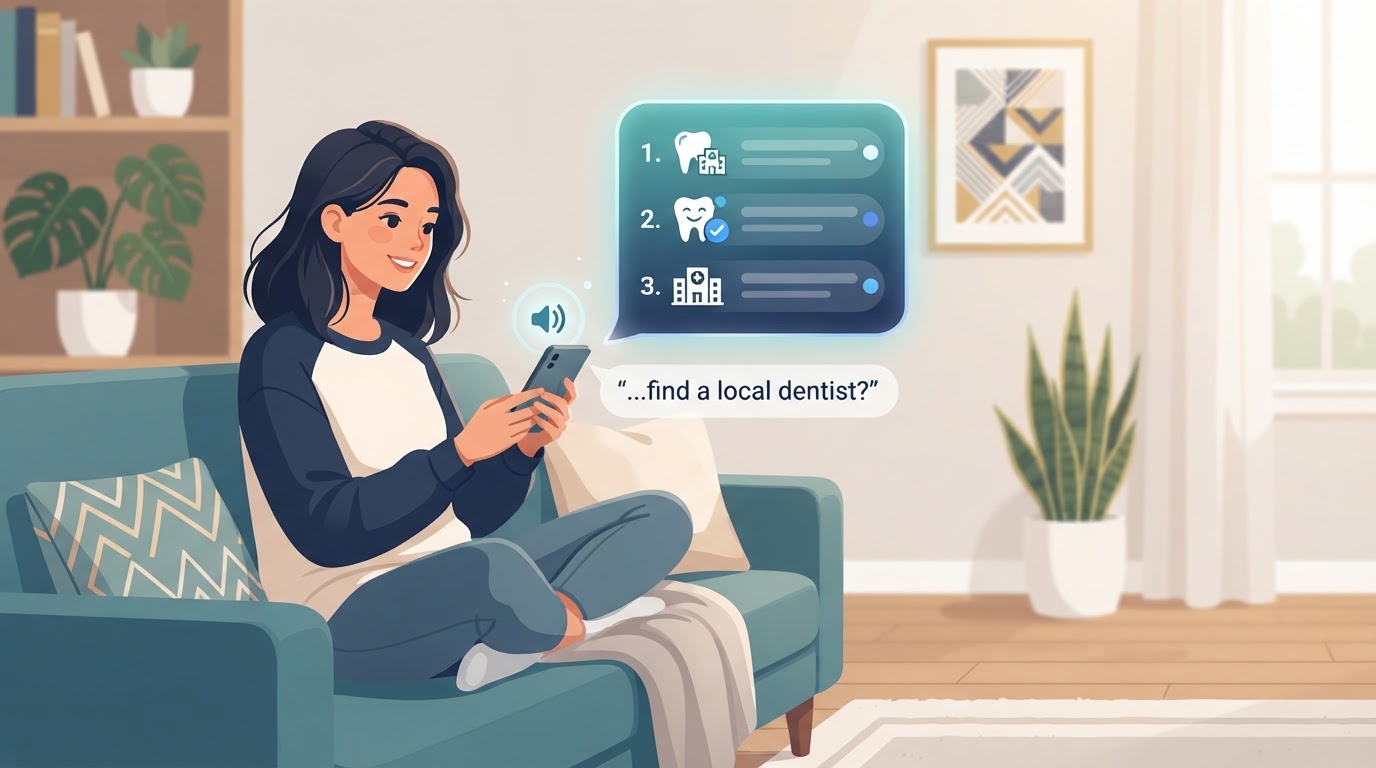
When an AI answers a patient's question, it doesn't list every dentist in town. It names a few, and the ones it names share the same signals:
- 1.Reviews that mention specifics — gentle, great with kids, painless implant. AI reads the words in reviews, not just the star count. BrightLocal's 2026 Local Consumer Review Survey found 97% of consumers read reviews for local businesses, and 74% look for reviews from the last three months.
- 2.Consistent practice info — your name, address, hours, services and insurance match across your site, Google and directories. Inconsistency makes AI less confident in you. Google's own guidance notes that Google ranks local results on relevance, distance and prominence, so consistent information everywhere helps you show up.
- 3.Detailed service pages, one per key procedure — each page answers cost, comfort and process for that treatment, so AI has something concrete to cite.
- 4.Dental schema markup — structured data that tells AI in machine-readable terms what you are, where you are and what you offer.
- 5.Third-party mentions — local media, best-dentist lists, associations and other sources that signal you're an established, trusted practice.
- 6.Strong dental SEO underneath it all — AI answers are built on top of search, so dental SEO services are still the foundation. Google says there are no special optimizations needed to appear in AI Overviews beyond SEO best practices.
Go deeper in What Is Dental GEO SEO?.
What does a page AI can recommend look like?
Take dental implants, the procedure patients ask AI about most. A page that AI can confidently recommend isn't a few paragraphs of marketing copy. It starts with who the treatment is for — someone missing a tooth, struggling with a denture, or facing an extraction. It explains what affects the cost and how payment, insurance and financing work, without quoting a single price you can't honour. It walks through what happens at each appointment — consult, imaging, placement, healing, the final crown — so a nervous patient can picture the path. It names how comfort and anxiety are handled, from sedation to a calm team, and what recovery looks like at home. It ends with a short FAQ answering the questions patients actually ask, and reviews from real implant patients describing the experience in their own words. That page gives AI everything it needs to describe you, trust you, and name you when a patient asks.
Why does random dental marketing fail in AI search?
Here's the trap. Generic AI-written posts and inconsistent listings make a practice blurry to AI. When every page sounds the same and your information differs from one listing to the next, the AI can't describe you confidently, so it skips you. Stop Random Dental Marketing breaks down why more content without a plan just makes the noise louder — and AI search makes that noise cost you patients.
How do you get your practice recommended by AI?
- 1.Ask ChatGPT and Google the questions above for your city and note who's named. That's your real competitive set in AI search, and it may not match who you think it is.
- 2.Audit your practice information everywhere — website, Google Business Profile, directories. Make the name, address, hours, services and insurance identical across all of them.
- 3.Build or upgrade a page for each priority procedure — implants, Invisalign, emergency, family, cosmetic. Each one answers cost, comfort and process in plain language.
- 4.Ask patients for reviews that mention the treatment and experience — 'gentle with my anxious kid' tells AI far more than 'great dentist.'
- 5.Add an FAQ to every service page — AI loves structured questions and answers, and they're often exactly what a patient is asking.
What does this look like in a real practice?
Dr. Jesse Chai's practice competes with 17 dental clinics within 1.5 miles. We built the Reviews Hero System, which produced 700+ authentic five-star Google reviews for the practice. That wall of detailed reviews compounds trust and Map Pack ranking — the same signals AI tools read when they recommend a dentist. As part of one accountable marketing system, the practice achieved a 29X documented return on marketing investment and 5X qualified leads. We're not claiming specific AI recommendation results here; the point is that the signals AI relies on are the same ones a focused, accountable system builds. Read the full Bradford Family Dentistry case study.
What does AI tell patients about your practice?
Before you change anything, find out what AI is actually saying about you. Start with a free dental marketing checkup or book a discovery call, and we'll show you what patients see when they ask an AI to recommend a dentist in your area — and what to fix first.
Do patients use ChatGPT to find a dentist?
Yes. More patients ask ChatGPT, Gemini and Google AI Overviews questions like 'Who's a good dentist near me for nervous patients?' and read the few practices the AI names.
How does AI decide which dentist to recommend?
AI favours practices with specific reviews, consistent information everywhere, detailed service pages, schema markup and third-party mentions — all built on strong dental SEO.
How can my practice show up in AI recommendations?
Audit your information everywhere, build a page per priority procedure that answers cost and comfort, collect reviews that mention specifics, and add an FAQ to each service page.
Do reviews matter for AI search?
Yes — AI reads the words in reviews, not just the star count. BrightLocal's 2026 Local Consumer Review Survey found 97% of consumers read reviews for local businesses, and 74% look for reviews from the last three months. Reviews that mention a treatment and how it felt ('gentle, painless implant') help AI describe and recommend you.
Is dental SEO still important?
Yes. AI answers are built on top of search, so strong dental SEO is still the foundation that makes everything else — service pages, schema, reviews — visible to AI.
What should a dental service page include to show up in AI answers?
Who the treatment is for, what affects the cost and how payment works, what happens at each appointment, how comfort and anxiety are handled, recovery, a short FAQ, and reviews from patients who had that treatment.
How long does it take for AI to start recommending my practice?
It varies by platform. Tools that search the live web, like Google's AI and Perplexity, can reflect changes within weeks, while others lean on older data and move more slowly.
Ian Cantle
Founder & Chief Marketing Strategist
Ian Cantle has spent over 20 years helping independent dentists and orthodontists dominate their local markets, build strategy-first marketing systems, and increase practice valuation.
Ready to Put This Strategy to Work in Your Practice?
Book a free Discovery Call with Ian Cantle. We will evaluate your local market, search presence, and patient acquisition strategy with no pitch and no obligation.
Book Discovery Call With IanRelated Insights
View All PostsWhat is Dental GEO SEO? Understanding Generative Search for Dentists
Demystifying Generative Engine Optimization for dentists and orthodontists. Why your website structure must communicate clearly with AI crawlers.
Stop Random Dental Marketing: Why AI-Generated Posts and Ads Aren't Filling Your Chairs
AI lets you pump out posts, ads and emails in minutes, so many practices do more marketing than ever with no plan tied to the patients they want. That creates noise, not new patients. Here's the strategy-first fix.
Find the Best Dental SEO Company for Your Practice
Are you a dentist or practice manager that wants to find the best dental SEO company? This article will help you determine the best fit. Odds are if you're reading this blog post, you know this already: getting your practice online is a must in the modern age. You know you need to great a […]