
If you can drill the perfect composite and place a flawless crown, you already know what clinical excellence looks like. The problem is, a clean diagnosis and a beautiful restoration do not automatically fill your schedule.
In 2026, the dental market is dense. There are plenty of great dentists. So patients do not choose based on who is best at dentistry. They choose based on who shows up first when they search on their smartphone and who answers fastest when they reach out.
That is why you can have a quiet waiting room even though your work is excellent. Patient acquisition is an operational problem. And like any operational problem, it is not solved by trying harder. It is solved by building the right system for your constraints.
Table of Contents
- 🦷 The “clinical excellence” trap (and why location matters less than you think)
- ⚖️ The real local dental marketing dilemma: capital vs. time
- ✅ Your baseline: mobile optimization, local SEO, and online reputation
- 🛠️ The “sweat equity” side: free or cheap strategies that burn time
- 💸 The “capital injection” side: paid strategies that buy time
- 📨 The missing piece in most marketing plans: email marketing and automation tools
- 🧠 How to pick your lane: time poor or cash constrained?
- 🧱 Practical playbook: build your marketing stack based on bottlenecks
- ❌ The common mistakes this framework helps you avoid
- 📌 What to do next: a simple decision checklist
- 🧩 FAQ
- 🔚 Final thought: pick a lane, then build a system that converts
🦷 The “clinical excellence” trap (and why location matters less than you think)
Let’s be honest. If you’re a dental practice owner, you have heard the same pitch from the same agencies. Your inbox is full of messages promising growth “overnight” with a “highly specific tactic.”
Then the pitch turns into a buffet of tactics you are supposed to run all at once:
- Facebook ads
- Local SEO
- Daily social media
- Mobile optimization
- Yelp reputation management
- Blog content
- Email marketing
- Local events
- Referral programs
- More tools, more strategies, more “must-dos”
When a practice actually tries to implement all of it simultaneously, the result is predictable: operational paralysis. Your front desk team is stretched too thin to execute any single tactic well. The owner is trying to manage it all. And the marketing plan becomes one more thing that causes stress and eats time without producing reliable patient flow.
Here’s the uncomfortable truth: treating every marketing idea as equally important does not create growth. It guarantees burnout and a blown budget.
⚖️ The real local dental marketing dilemma: capital vs. time
Local dental marketing has one core dilemma:
You are spending either your practice’s capital or your staff’s available time.
Think of it as a trade-off:
- Sweat equity: low indirect cash cost, but heavy lifting from your team and owner. You pay with hours.
- Capital injection: higher software and marketing spend, but it buys back time. You pay with money.
This matters because most dental marketing advice ignores operational bandwidth. It tells you what “should” work, not what you can realistically execute consistently.
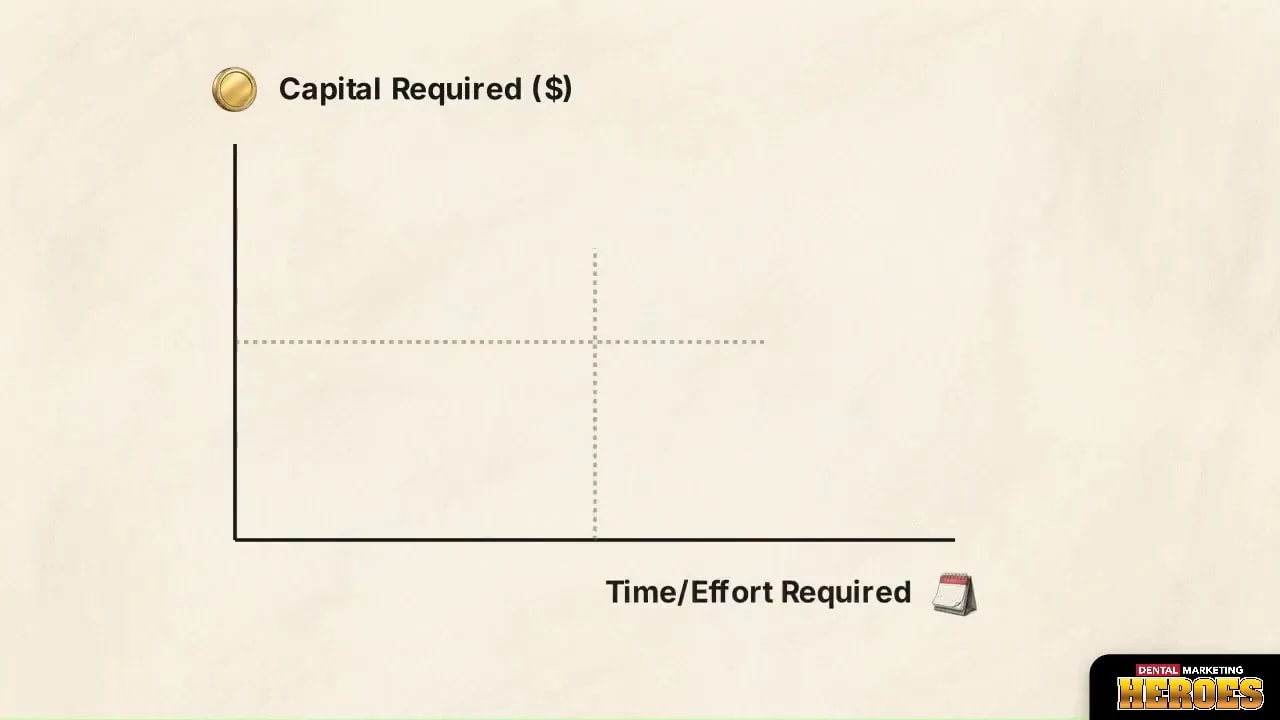
So instead of copying a generic playbook, you need a framework that shows what each strategy truly costs you to run.
A helpful way to visualize it is as a quadrant with:
- Vertical axis: capital required (money, software, ads)
- Horizontal axis: time required (staff hours, owner hours, ongoing effort)
Then you can map strategies onto the grid to see where they land for your practice.
✅ Your baseline: mobile optimization, local SEO, and online reputation
Before you chase growth tactics, you need three foundational pieces for local visibility. These are not glamorous. They are not “viral.” But if they are broken, every other marketing dollar underperforms.
📱 1) Mobile optimization (moderate time, low capital)
Mobile optimization is one of those boring essentials that quietly increases conversion rates.
You spend hours building or improving a responsive website. Once it’s in place, it yields results over time because patients are more likely to book when the site loads fast and the call-to-action buttons actually work on a phone.
Mobile optimization is not a one-time project you “finish and forget.” But it’s also not something you re-do every week. It’s a steady investment.
If you’re unsure whether your site is turning traffic into appointments, this resource is a great next step:
https://dentalmarketingheroes.com/website-conversion-helpful-tools/
📍 2) Local SEO (higher time, low to moderate capital)
Local SEO moves further into the “time” side. You maintain your Google Business Profile, manage local directory listings, and keep your on-page local signals consistent.
Local SEO pays off because it captures high-intent searchers. People are literally typing:
- “dentists near me”
- “emergency dentist in [city]”
- “dentist for Invisalign [neighborhood]”
Local SEO intercepts patients who are already looking for you.
If you want a deeper guide, start here:
https://dentalmarketingheroes.com/local-seo-for-dentists/
⭐ 3) Online reputation management (high time, low capital)
Reputation management is where many practices accidentally fail, because it requires staff discipline.
You need a system to consistently ask for reviews right after appointments. Not “someday.” Not “when we remember.” Immediately, while the experience is fresh.
That discipline is why reputation management sits deep in the high-effort, low-cash quadrant.
If your reviews are fewer than your competitors, it’s not just a branding issue. It affects local ranking and patient trust at the point of decision.
Use these resources to build review flow:
https://dentalmarketingheroes.com/how-to-generate-great-dentist-reviews/
https://dentalmarketingheroes.com/6-easy-ways-to-ask-for-reviews/
Important: If these three foundations are not locked down, spending on ads is often wasted. Ads can bring traffic. But without a site that converts, local SEO that positions you, and reviews that build trust, you will pay for clicks that do not become booked appointments.
🛠️ The “sweat equity” side: free or cheap strategies that burn time
Once your baseline is stable, you can expand. But the next mistake is copying the marketing stack of someone whose operational constraints are completely different than yours.
The sweat equity quadrant holds strategies that cost little in cash, but demand hours of effort.

📝 1) Blogging and content creation (low capital, high effort)
Blogging can help establish authority and improve long-term SEO visibility. But it is not instant and it requires consistent output.
If you do it properly, you need:
- Topic planning around patient questions and local intent
- Writing or producing helpful content
- On-page SEO
- Promotion (social, email, retargeting, etc.)
This is why blogging often looks attractive on paper and painful in execution.
If you want a starting point, here’s a useful post on getting value from a dental practice blog:
https://dentalmarketingheroes.com/get-traffic-with-dental-practice-blog/
📣 2) Social media engagement (low capital, high owner hours)
Social media is great for building community familiarity and credibility. It can also support your local SEO and reputation indirectly. But it has one major operational cost: time.
“Daily posting” sounds doable until you realize your front desk and owner time are already full. Social media becomes another task competing with clinical and administrative priorities.
If you need fresh ideas that do not require your entire week, explore:
https://dentalmarketingheroes.com/fresh-social-media-marketing-ideas/
🏘️ 3) Local events (massive goodwill, but high effort)
Community events are powerful. A free community dental checkup day generates goodwill and word of mouth referrals you cannot directly buy.
But events are real work:
- Planning logistics
- Coordinating staff schedules
- Generating promotion
- Capturing leads and reviews
This is why community events sit at the extreme end of the “low cash, high time” quadrant. They are not wrong. They are just expensive in a way most marketers do not measure.
If you are exploring how to get more mileage from local outreach, this post may help:
https://dentalmarketingheroes.com/10-local-marketing-ideas-to-try-now/
💸 The “capital injection” side: paid strategies that buy time
On the opposite side of the matrix are capital accelerators. These strategies require dedicated financial budget, but they reduce the operational burden on your team.
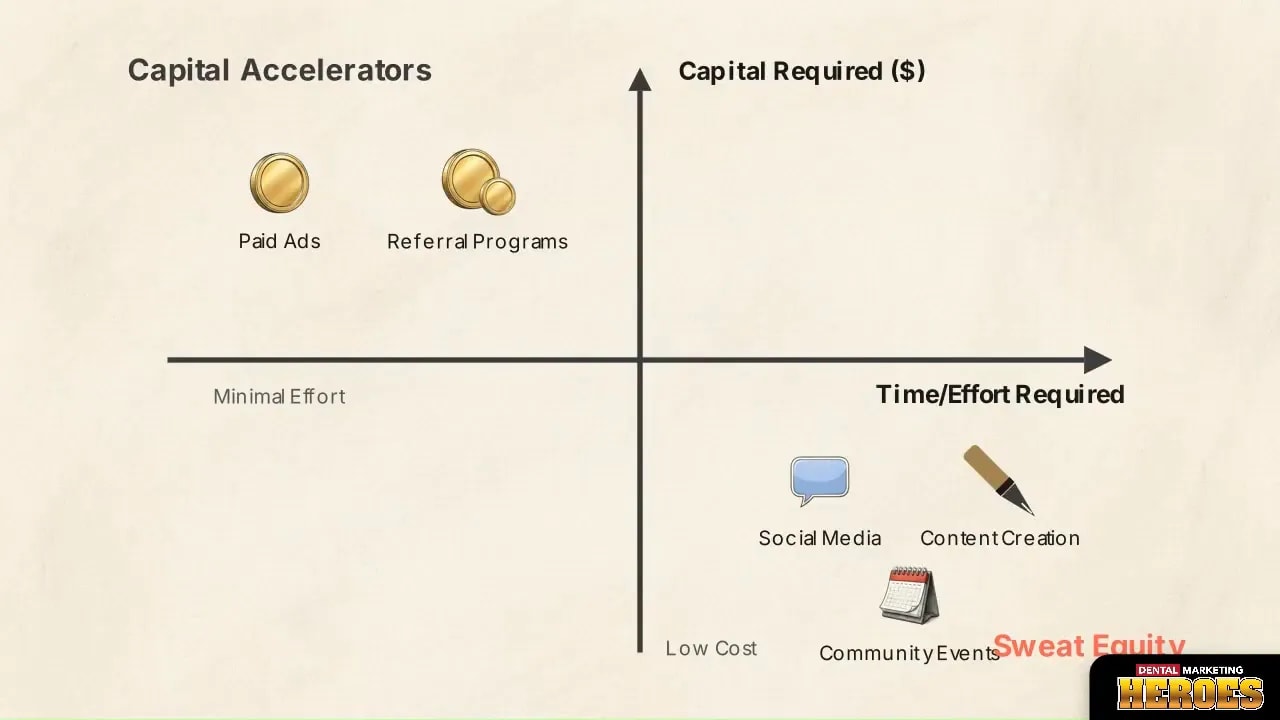
📣 1) Paid advertising (high speed, hands-off execution)
Paid ads can produce visibility quickly. Instead of waiting for content to rank, you can buy attention in front of high-intent local audiences.
But the key is how you use ads. Ads are not the entire marketing system. Ads are a distribution engine.
Your ads must feed into:
- A mobile-optimized website
- Strong calls to action
- Review signals (so patients trust you)
- Lead capture and follow-up
- Conversion processes at the front desk
If any of those fail, ads become a recurring expense with limited ROI.
If you want to understand ad objectives more clearly, use:
https://dentalmarketingheroes.com/facebook-ad-objectives-simplified/
🤝 2) Referral programs (paid or incentivized, but time-efficient)
Referral programs can be an incredibly strong patient acquisition engine, especially when you are serious about activation and follow-through.
On paper, referral programs can feel like “sweat equity.” In practice, you may need:
- Incentives or subsidized rewards
- Staff scripting and tracking
- Automation to request referrals and nurture leads
That’s why referrals often move into the capital acceleration quadrant. You can fund systems that reduce staff effort.
For a full guide, start here:
https://dentalmarketingheroes.com/patient-referral-new-patient-acquisition/
Core trade-off to remember:
- Sweat equity builds permanent community trust “for free,” but it costs staff hours.
- Capital buys immediate traffic, but when funding stops, results stop.
Neither side is inherently better. The right choice depends on what you can execute consistently without damaging your practice operations.
📨 The missing piece in most marketing plans: email marketing and automation tools
There are two strategies that sit awkwardly if you do not have a back-end operational system: email marketing and marketing automation.
If your leads come in from events and ads but you do not capture them properly, follow up quickly, and nurture them, you will leak potential patients through the cracks.
That leakage is one of the most expensive “hidden costs” in dental marketing.

🧰 Email marketing tools: entry-level to advanced
Entry-level email tools help you send newsletters and basic follow-up:
- Mailchimp (email-focused)
- Hootsuite (social management, but often isolated)
Advanced CRM platforms can track complex interactions in one dashboard. For example:
- HubSpot (CRM and multi-stage tracking)
⚙️ Omnichannel automation: the force multiplier
Omnichannel automation platforms combine multiple channels and workflows into one system. A key example mentioned is:
- Engagement Engine (combines SMS, reputation signals, and funnels)
Here’s the trade-off: omnichannel automation usually has higher initial software cost and requires a learning curve to build funnels properly.
But once configured, automation changes your marketing from a daily chore into a background system.
Instead of your front desk constantly repeating manual tasks, automation can:
- Catch leads from every channel
- Follow up consistently
- Convert inquiries into booked appointments
- Nurture people who are not ready right now
- Support review generation and reputation loops
In other words, automation becomes a multiplier. Your investment in top-of-funnel strategies (SEO, ads, events, social) finally has a conversion engine behind it.
If you want to improve patient engagement with email, this post is directly relevant:
https://dentalmarketingheroes.com/the-ultimate-guide-to-email-marketing/
And if your real bottleneck is retention, you may also like:
https://dentalmarketingheroes.com/increase-patient-retention-with-email/
🧠 How to pick your lane: time poor or cash constrained?
All of this becomes simple when you stop asking, “What marketing works?” and start asking, “What will we actually execute consistently?”
The framework is straightforward:
- Do you have more time? Lean toward sweat equity strategies.
- Do you have more money? Lean toward capital injection strategies.
The video’s decision logic is built around schedule capacity:
- If your schedule is under 50 percent full, cash flow is constrained. Lean into sweat equity: local SEO, community events, and manual review extraction.
- If you are a solo practitioner working maximum clinical hours, the sweat equity pathway may break you. You need capital to buy back your time.
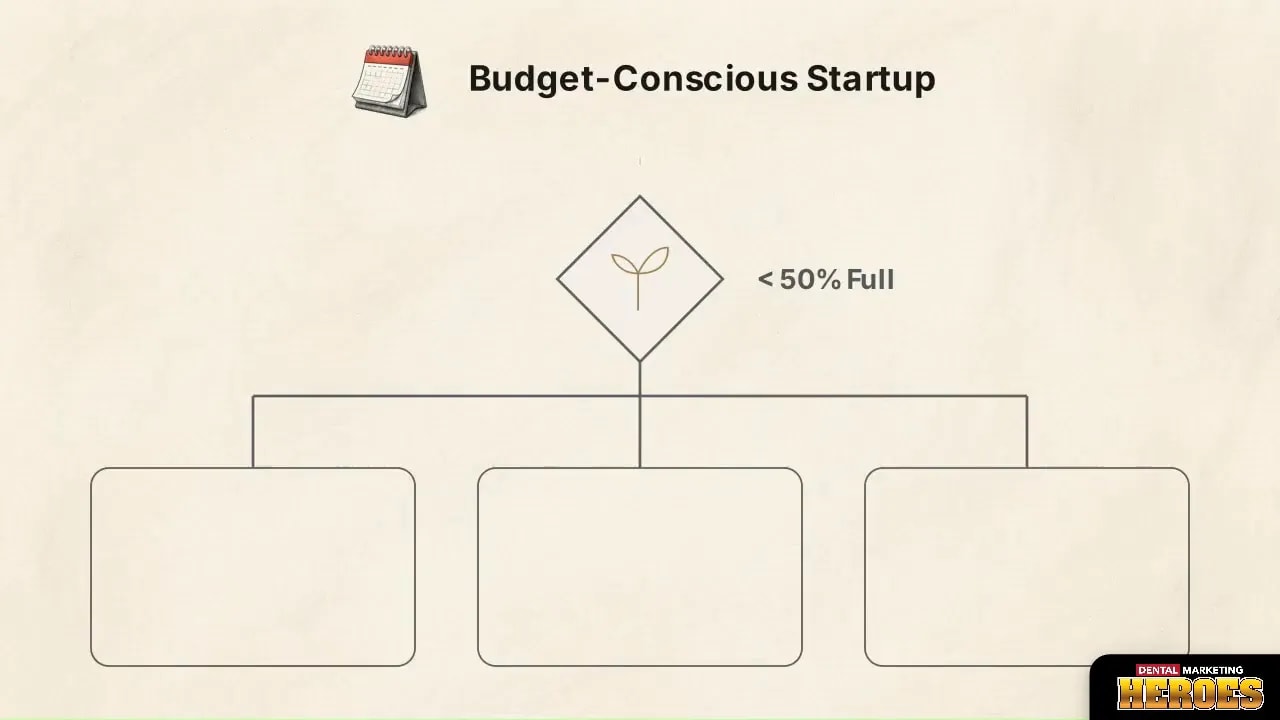
🕰️ Budget-conscious startup path: under 50% schedule capacity
If your calendar is not full yet, you have a typical problem: limited cash flow, and marketing needs to be low-cost enough to survive.
In this scenario, sweating equity can be the correct move, because you are paying with your hours instead of your budget.
A realistic sweat equity plan often includes:
- Master local SEO basics (Google Business Profile, local citations)
- Host community events (free checkups, workshops, local goodwill)
- Extract Google reviews manually from every patient (with a script and routine)
- Use content strategically, not obsessively (choose a few topics you can sustain)
But even here, you still need to avoid operational paralysis. Sweat equity is not “do everything for free.” It is “choose a few high-impact tasks you can execute well.”
📈 Growth optimizer path: established practice with packed schedule
If your schedule is already full and you are trying to scale, expand, or hire an associate, your limiting factor is time.
In that situation, sweat equity becomes destructive. Attempting to add more manual marketing tasks on top of an already full clinical workload often leads to:
- Slow lead follow-up
- Inconsistent reviews
- Lower conversions
- Eventually, burnout
The growth optimizer approach is to deploy capital to remove marketing from your daily task list.
That typically means:
- Adopting omnichannel automation systems
- Funding highly targeted paid ads
- Using specialized support so the front desk stays focused on patient care
Because you are time poor, it can make sense to use a specialized agency to handle paid acquisition and run CRM operations effectively. The goal is simple: make marketing run in the background while your clinical operations move forward.
If you want help designing the marketing system holistically (not piecemeal tactics), this related page may be useful:
https://dentalmarketingheroes.com/dental-marketing-system-to-grow-practice/
🧱 Practical playbook: build your marketing stack based on bottlenecks
Let’s turn the capital-and-time framework into a practical way to build your stack. This is the part most dentists skip, and it’s why marketing feels unpredictable.
Use this “bottleneck first” approach:
- Audit your baseline
- Is your website mobile-friendly and built for conversions?
- Is your Google Business Profile maintained?
- Do you have a review-request routine with staff accountability?
- Identify your operational constraint
- Do you have time to do sweat equity every week?
- Or do you need to buy back time with capital?
- Choose one growth lever to prioritize
Not ten. One lever.
- Build the lead capture and follow-up layer
Even the best ad or SEO campaign fails if you cannot convert inquiries into appointments.
- Measure conversions, not vanity
- Calls answered
- Form submissions
- Booked appointments
- Show-up rate
- Review volume growth
This is where automation earns its place. It ensures top-of-funnel activity doesn’t disappear into the void.
❌ The common mistakes this framework helps you avoid
🚫 Mistake 1: chasing isolated marketing hype
Most marketing tactics are not “bad.” The problem is isolation. If you run ads without follow-up automation, or you post on social without a conversion path, you are spending energy without turning it into booked patients.
🚫 Mistake 2: doing everything at once
Trying ten strategies simultaneously is not a growth plan. It’s a stress plan.
🚫 Mistake 3: ignoring the front desk workload
Your front desk team is the operational bridge between marketing and appointments. If marketing creates demand faster than the team can respond, you will waste leads.
🚫 Mistake 4: paying for traffic before fixing reputation and conversion
Ads bring attention. Reviews and conversion infrastructure determine whether attention becomes bookings.
📌 What to do next: a simple decision checklist
If you want a quick way to decide what lane to pursue, use this checklist:
- Is your schedule under 50% full? Lean into sweat equity: local SEO, community goodwill, and review extraction.
- Are you working maximum clinical hours as a solo practitioner? Lean into capital injection: targeted ads and automation that reduces front desk burden.
- Do your leads go nowhere after they inquire? Add or improve email marketing and automation.
- Do you have fewer reviews than competitors? Fix your reputation system before increasing ad spend.
- Is your website slow or hard to use on mobile? Fix mobile optimization first.
This approach is how you stop guessing and start building patient acquisition as an operational system.
🧩 FAQ
How do I know whether to use sweat equity or paid ads for my dental practice?
Start with constraints. If your calendar is under 50% full and cash flow is tight, sweat equity can be the right starting point because you pay with time. If you are already working near maximum hours and need to scale, capital injection (targeted ads plus automation) is usually the more sustainable path because it buys back time and improves lead conversions.
What are the three foundation tactics every dental practice needs for local visibility?
Mobile optimization, local SEO, and online reputation management. If these are weak, spending on ads often delivers poor ROI because traffic will not convert and patients will not trust you.
Why do marketing strategies fail even when dentists “do them correctly”?
Most failures come from operational mismatches. A tactic may generate leads, but if your staff cannot respond quickly, follow up consistently, and convert inquiries into booked appointments, leads leak. Automation, lead capture, and conversion workflows fix that gap.
Does social media actually bring new patients to a dental practice?
Social media can support awareness and trust, but it rarely functions as a standalone patient acquisition engine. Its impact depends on what comes next: your mobile conversion path, your review signals, and your follow-up system. Without those, posting becomes a time sink.
What’s the fastest way to generate qualified dental leads locally?
Often, the fastest lever is capital injection through targeted paid advertising, provided your website, reputation, and lead follow-up are ready. For longer-term compounding visibility, local SEO is essential, but it takes ongoing effort to maintain and improve rankings.
What email marketing and automation tools should I start with?
At an entry level, tools like Mailchimp can support email outreach, while platforms like Hootsuite may help manage social. As you need more tracking and lead-stage visibility, consider an advanced CRM like HubSpot. For full lead-capture and follow-up across channels, omnichannel automation platforms (example: Engagement Engine) can combine SMS, reputation signals, and funnel workflows.
How can I build a referral program that doesn’t become another burden for my staff?
Choose a referral program structure that reduces steps for staff. Then use systems to track and activate referrals, and consider incentives if you need faster participation. For deeper guidance, review the referral-focused approach here: https://dentalmarketingheroes.com/patient-referral-new-patient-acquisition/
🔚 Final thought: pick a lane, then build a system that converts
Most dental practices do not need more marketing ideas. They need a better marketing operating model.
Use the sweat equity vs. paid ads trade-off to choose what you can execute without burning out your team. Lock in the foundations (mobile optimization, local SEO, reputation). Then add lead capture and follow-up so your marketing produces booked appointments, not just activity.
If you want more structured guidance on building the right plan and avoiding waste, these resources align closely with the system mindset:
- https://dentalmarketingheroes.com/the-perfect-dental-marketing-plan/
- https://dentalmarketingheroes.com/does-your-dental-marketing-suck/
- https://dentalmarketingheroes.com/dental-marketing-blog/
- https://dentalmarketingheroes.com/dental-marketing-system-to-grow-practice/
When you build around your actual constraints and automate lead conversion, your marketing stops being a daily battle. It becomes a background engine that catches and converts demand while you focus on clinical excellence.
Ready for a focused strategy? You can schedule a complimentary consultation with Dental Marketing Heroes to map your next steps and build a marketing engine that fits your time and budget.
GET YOUR FREE DENTAL MARKETING EBOOK
7 Steps To Dental Practice Marketing Success